The Kick Sled and What to Buy
North House's three-day kick sled class with Randy Schnobrich. The Nordic spark from the drög and the first wooden-runner sleds to Orsa's 1909 spring steel, how a kick sled works and how big it is, the birch, glue, plastic, and hardware for a 72-inch sled, and a plan for the class's Friday evening and two full days.
- 4 min
- 6 steps
- 2 questions
- Lesson 151 of 204
In this lesson
- How it works
- From drög to Orsa
- How big
- What to buy
- Try it
Picking up where you left off.
What you need
| Have it | Material | Spec | Qty | Where to get it |
|---|---|---|---|---|
| Runner stockAsh, red oak, or white oak also bend well. | Yellow birch, 6/4 (planed to 1 1/4 in), clear and straight-grained, about 6 in wide and 7 ft long | 1 board (rips into 16 strips plus spares) | A hardwood dealer; ask for straight grain without runout | |
| Chair stock | Birch, 8/4 for posts and legs, 4/4 for seat rails, slats, blocks, braces, front bar, and handlebar | About 12 board feet | A hardwood dealer or lumberyard | |
| Form material | 3/4 in MDF, ripped into 6 in strips at the store | 1 sheet, 4 x 8 ft | Mother Earth News | |
| EpoxyStructural and water-resistant; needs only light clamping pressure. | Two-part laminating epoxy, slow hardener | About 1 quart kit | A boat or woodworking supplier | |
| Runner bottomsOr pine tar on bare wood, the old way. | UHMW polyethylene strip, 1/8 x 1 in | Two pieces 6 ft long | A plastics supplier | |
| Hardware | 1/4-20 carriage bolts 2 1/2 in with washers and wing nuts; #8 wood screws; #6 flat-head stainless screws for the UHMW | 12 bolts; a box of each screw | Hardware store | |
| Foot treads | Rubber matting or outdoor grip tape | Two strips about 3 ft long | Hardware store | |
| Finish | Spar varnish or an exterior oil finish | 1 pint | Hardware or paint store |
Tools
Checkmarks are saved on this device.
The plan
-
Day 1 (evening)
Form and strips
- Draw the runner curve and cut the form template
- Stack and trim the form pieces; tape the face
- Rip and thickness the runner strips
-
Day 2
Glue-up and chair parts
- Dry-clamp a runner to rehearse; then epoxy and clamp both runners
- Mill posts, legs, seat rails, slats, and braces
- Lay out and cut the joints; shape the front bar
-
Day 3
Assemble and fit
- Unclamp the runners; scrape, plane, and round them
- Glue and screw the blocks; bolt on posts and legs
- Fit seat, braces, and front bar; shape the handlebar to your height
- Screw on the UHMW strips and foot treads
-
At home
Finish
- Take it apart, sand, and finish every piece
- Reassemble, then ride on hard snow or ice
This module reconstructs North House Folk School’s Kick Sled Building: Push and Glide with Randy Schnobrich, a Grand Marais woodworker who moved to the North Shore from Wisconsin in 1994 and has mushed dogs and taught at North House for over 20 years 1. Students build a kick sled of birch, from laminating wood for the runners to shaping a customized handlebar for steering, with hand and power tools. The finished sled is 72 inches long, 16 wide, and 36 high, and it collapses for transport 2. The class runs a Friday evening and two full days, with a $290 materials fee 3. The plans aren’t published; the design in this module is worked out from those dimensions and the sources cited.
How it works
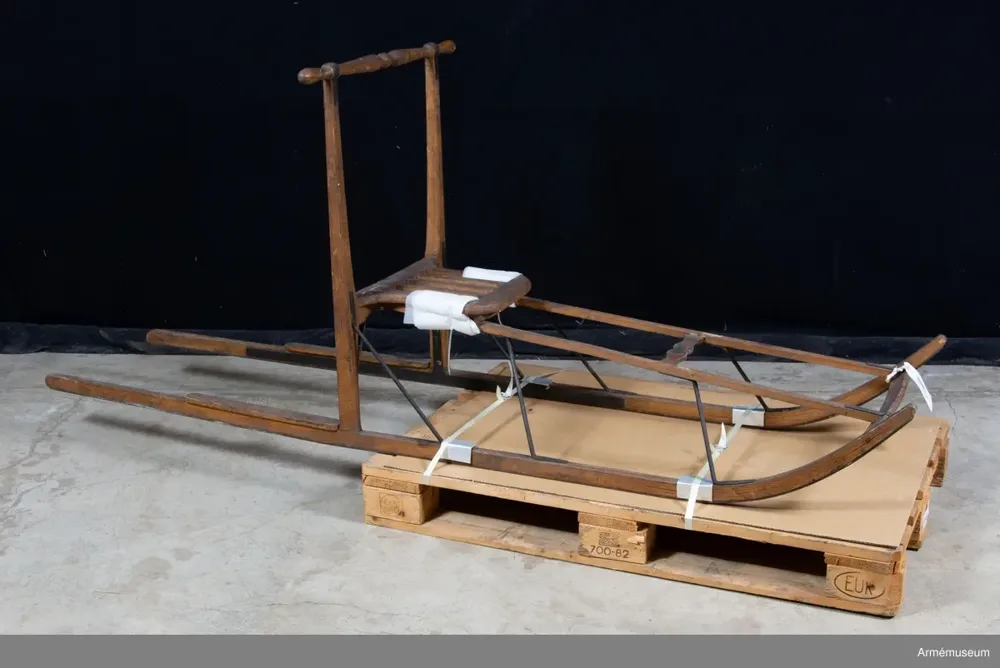
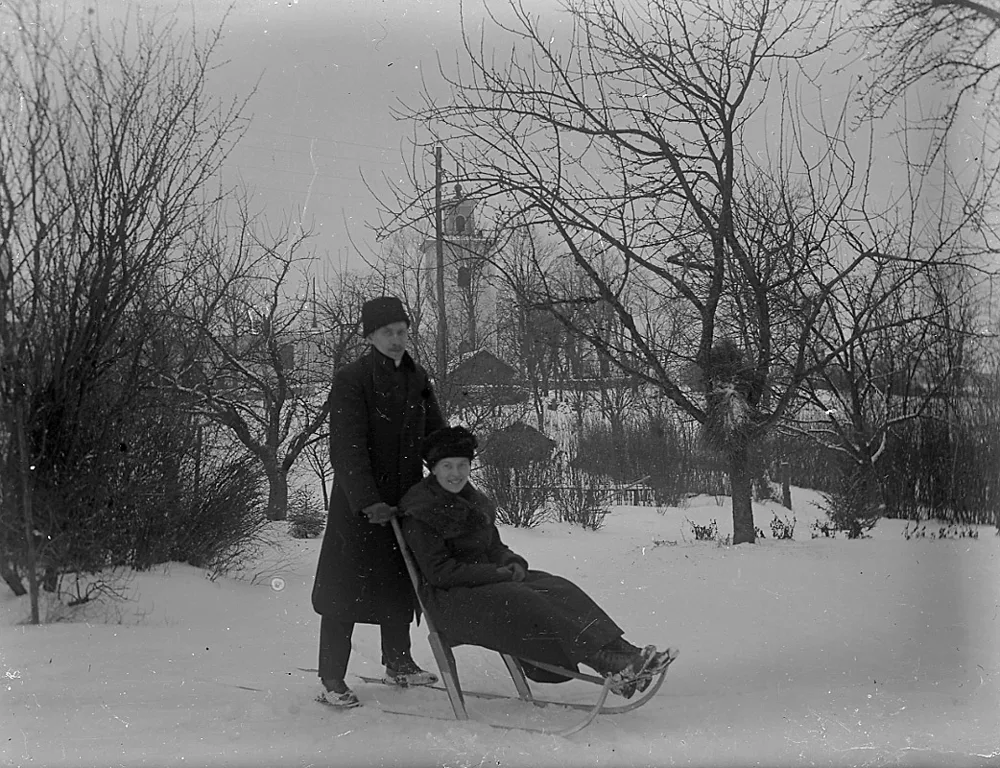
A kick sled, spark or sparkstötting, is a chair on two long runners, joined at the front by a bar, with a handlebar across the top of the chair back. The runners continue behind the chair about twice as far as the chair is long. You stand on one runner and kick with the other foot, which is where the name comes from 4 5. A passenger or a load rides on the seat 5; an old photograph by Anna Hedström shows a man pushing a woman seated on one 6.
It needs ice or hard-packed snow; it won’t run on sanded or salted roads. On those surfaces 15 to 20 km/h comes easily 4, and it’s good for getting out to ice fishing 4.
Quick check
That’s where you stand and kick; the 72-inch class sled has about 38 inches behind a 20-inch chair.
From drög to Orsa
The kick sled grew from the drög, a short, wide load sled with uprights that the driver stood behind on one runner 4. It’s generally said to have been invented in upper Norrland in the later 1800s, though Stockholm reports go back to the late 1700s 4; the first definite record is a northern Swedish newspaper around 1870 5. Kick sled racing was a popular sport from 1890 to 1910 and an event in the Nordic Games 5.
Early sleds had stiff wooden runners and were heavy 5. Their runners were iron-shod or boiled in tar to glide in hard cold, and wooden runners could split in sharp turns 4. Thonet, the bentwood furniture maker, sold kick sledges in its 1904 catalogue: two long thin runners, a post and handlebar in the middle, a bench-like seat in front, and foot plates on the runners behind; riders strapped crampons to their shoes 7. A Swedish army trial model from 1914, with wooden runners, is 220 cm long and 104 cm high 8.
In 1909 the Orsa factory brought out the Orsaspark, with patented spring-steel runners 4, and flexible metal runners quickly became standard in Sweden, Finland, and Norway 5.
Quick check
Earlier sleds had stiff wooden runners, iron-shod or tarred, that could split in sharp turns.
How big
What to buy
- Birch for runners and chair. Yellow birch is one of the good bending woods 10; ash, red oak, and white oak also bend well 11.
- MDF for the bending form, ripped into strips at the store to save dust 11.
- Epoxy for the runner laminations: structural, water-resistant for limited outdoor use, gap-filling, and it needs only light clamping pressure; it’s used for laminating boat hulls and sports equipment 12. Ordinary yellow glue is rated for interior use 12.
- UHMW plastic for the runner bottoms: a very low-friction, abrasion-resistant plastic that hardly absorbs water. It doesn’t bond well, so it gets screwed on 13.
- Bolts and wing nuts, so the chair comes off the runners and the sled packs flat, as North House’s does 2.
Playback is optional. If the player is unavailable, open the video at its source.
Try it
Before buying wood, stand behind a kitchen chair with your hands on its back, one foot lifted as if kicking. Have someone measure from the floor to your palms. That’s your handlebar height; check it against the 36 inches of the class sled and the 73-95 cm range of a sport sled 9.
Lesson complete
Nice work.
Sources for this lesson
- 1Randy Schnobrich. North House Folk School. verifiedGrand Marais woodworker who moved to the North Shore from Wisconsin in 1994, built a log house and woodshop, has mushed dogs, and has taught at North House for over 20 years.
- 2Kick Sled Building: Push and Glide. North House Folk School. verifiedStudents craft a kick sled of birch, learning skills from laminating wood for the runners to shaping a customized handlebar for steering; hand and power tools. Up to two people per tuition; youth 8+ with an adult. Finished sled 72 in long, 16 in wide, 36 in high, and it collapses for transport.
- 3Kick Sled Building: Push and Glide (December 7-9, 2018). North House Folk School. 2018. verifiedInstructor Randy Schnobrich. Day 1 5-8 pm, days 2 and 3 9 am-5 pm. Tuition $200, materials fee $290. Bring a tape measure, a 6 in square, and eye protection; ear protection optional. Beginner to advanced.
- 4Sparkstötting. Wikipedia (Swedish). verifiedTwo runners, usually steel, joined at the front by a bar; a chair on top, traditionally wooden, with a handlebar at the top of the back; the runners continue behind the chair about twice as far. You stand on one runner and kick with the other foot. Only on ice or hard-packed snow, not sanded or salted roads; 15-20 km/h comes easily; used for ice fishing. Grew from the drög, a short load sled with uprights. Generally held to have been invented in upper Norrland in the later 1800s, though Stockholm reports go back to the late 1700s. Early sleds: long runners with an upright stake each, joined by a seat; runners iron-shod or tarred to glide in hard cold; wooden runners could split in sharp turns. Orsasparken, 1909, Erik Timander and Anders Bertas, had patented spring-steel runners with an inverted-T profile at the front that doesn't cut into loose snow.
- 5Kicksled. Wikipedia. verifiedA chair on flexible metal runners that extend backward about twice the chair's length; handlebar on the chair back. Typical adult sled: runners about 2 m long, 400 mm apart; handlebars about 900 mm high. Steer by twisting the handlebars, flexing the runners. Plastic snow runners for deeper snow; spiked shoes or crampons on bare ice; 15-20 km/h on the level. First definite record in a northern Swedish newspaper around 1870; those sleds had stiff wooden runners and were heavy; Orsasparken's flexible metal runners in 1909 became standard in Sweden, Finland, and Norway. Scientific American described 'the Sparkstotting' in 1894. Racing popular 1890-1910 and in the Nordic Games; revived in Finland around 1990, races up to 100 km averaging about 30 km/h.
- 6En man och en kvinna med sparkstötting (OLM-2008-21-356). Örebro läns museum, via DigitaltMuseum. verifiedPhotograph by Anna Wilhelmina Hedström of a man and a woman with a kick sled in snow. Public domain mark.
- 7Thonet and winter sports. Thonet. verifiedThonet's bentwood maker also sold sledges, toboggans, skis, snowshoes, and kick sledges; its 1904 catalogue describes the kick sledge as two long, thin runners with a post and handlebar in the middle, a bench-like seat in front and foot plates on the runners behind; the rider straps crampons to the shoes, stands on one runner, and pushes off with long kicks.
- 8Sparkstötting m/1914 försök (AM.078409). Armémuseum, via DigitaltMuseum. verifiedA Swedish army trial-model kick sled of 1914 with wooden runners: length 220 cm, width 70 cm, height 104 cm. Given to the museum by Stockholm's equipment depot in 1936. CC BY.
- 9Kickspark MAX aluminium. Varuste.net. verifiedA Finnish sport kicksled: zinc-coated spring-steel runners 30 x 28 mm x 1500 mm (3 kg a pair); plastic snow runners 35 or 56 mm wide glide better than steel in snow or below about -10 C; ice runners for bare lake ice. Handlebar adjustable 73-95 cm; riders 130-200 cm tall; folds to 150 x 40 x 25 cm. On icy roads or lakes kick with studded boots or crampons. Racers reach 25-40 km/h.
- 10Rebecca E. Ibach. Specialty Treatments (Chapter 19). USDA Forest Service, Forest Products Laboratory (Wood Handbook, FPL-GTR-190). 2010. verifiedSteam or boil about 15 min/cm (38 min/in) of thickness at 20-25% moisture content, 30 min/cm (75 min/in) for drier wood. Plasticized wood compresses 25-30% parallel to the grain but stretches only 1-2%; bends needing more than about 3% difference between outer and inner faces need a metal strap with end fittings. Birch, ash, hickory, oak are good bending species. Cool and dry the piece held in shape. Laminated members: dry laminations bent without end pressure against a form and bonded in one operation; bending thin laminates needs only moderate stress, no steam, and gives stronger members than single-piece bends; laminated bends change shape less with moisture; thickness-to-radius ratios impossible in single pieces are easy; any length can be made.
- 11How to Build a Sled. Mother Earth News. verifiedCurved runners by bent lamination: thin strips glued together to a curve; lots of clamps and glue, but easier and safer than steam bending. Ash bends well; red or white oak also work. Form of stacked 3/4 in MDF strips, the curve drawn with a bent batten and string, the first piece cut and faired as a template and the rest flush-trimmed to it with a router; clamp holes drilled through the form.
- 12Charles R. Frihart, Christopher G. Hunt. Adhesives with Wood Materials: Bond Formation and Performance (Chapter 10). USDA Forest Service, Forest Products Laboratory (Wood Handbook, FPL-GTR-190). 2010. verifiedTable 10-2: phenol-, resorcinol-, and melamine-formaldehyde and isocyanates are structural and fully exterior; epoxy and polyurethane structural for limited exterior (short-term soaking); urea-formaldehyde interior; cross-linked PVA semistructural limited exterior; ordinary PVA nonstructural interior. Epoxy: two parts mixed by the user, limited pot life, cures at room temperature, needs only low pressure, high dry and wet strength, gap-filling; used for laminating boat hulls, architectural railings, and sports equipment; delaminates with repeated wetting and drying.
- 13Ultra-high-molecular-weight polyethylene. Wikipedia. verifiedVery low coefficient of friction, self-lubricating, highly resistant to abrasion, extremely low moisture absorption, resistant to most chemicals. It doesn't absorb water or wet easily, which makes bonding it difficult.