Frames, Trunnels, and Fitting Out
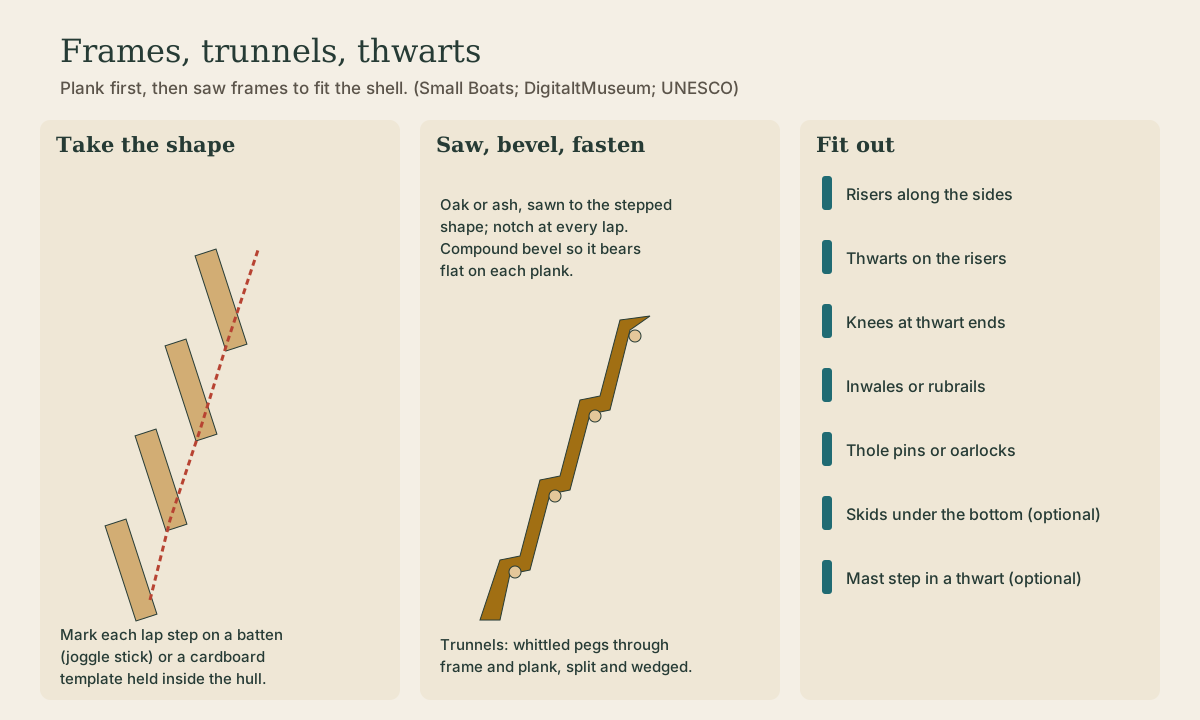
Day six: take each frame's shape off the finished shell with a joggle stick, saw it from oak or ash with a step at every lap, cut the compound bevels so it bears on every plank, and fasten it with whittled, wedged trunnels and rivets. Day seven: risers, thwarts, knees, inwales, and thole pins or oarlocks.
- 3 min
- 5 steps
- 2 questions
- Lesson 126 of 204
In this lesson
- Take the shape
- Saw and bevel
- Fasten with trunnels
- Fit out
- Try it
Picking up where you left off.
With the shell planked and fair, the frames go in. Sawing frames to fit a finished shell is the older Scandinavian practice, earlier than steam-bending 1.
Take the shape
At each frame station, take the shape of the inside of the hull, steps and all. A joggle stick is a thin batten held against the planking, marked where each lap step falls; a cardboard template cut and nibbled to fit works too. A small pram doesn’t need many: one Fredrikstad eke 4.4 meters long has six frames 2.
Quick check
Take the steps off the hull itself with a joggle stick or template.
Saw and bevel
Transfer the shape to straight-grained oak or ash about 5/4 thick and saw it out, with a notch stepping down at every lap. Each step needs a compound bevel, because the hull curves both along its length and around its girth, so the frame’s face meets each plank at an angle in two directions. North House’s class names exactly this skill: “compound bevels for framing” 3. Offer the frame up, mark where it rocks, pare, and offer it again until it bears on every plank at once with no daylight.
Fasten with trunnels
North House’s class fastens frames with trunnels (tree nails) 3. Whittle pegs from straight-grained oak or ash with the sloyd knife, slightly bigger than the hole, drive them through frame and plank, split the inboard end, and drive a small wedge across the grain of the plank to lock it. Thin frames can be riveted instead; Harry Bryan notes frames 1/2 inch or thinner are best riveted 4. North House publishes no trunnel size; on planks this thin, keep the pegs small (around 3/8 inch) so the holes don’t weaken the planking.
Quick check
From ‘tree nail.’ North House’s class fastens frames with them.
Fit out
Day seven turns a shell into a boat:
- Risers: battens fastened along the inside of each side to carry the thwarts.
- Thwarts: seats across the boat, resting on the risers. The Fredrikstad eke has three thwarts on knees 2; an 11-footer needs two or three.
- Knees: grown or sawn hardwood brackets tying thwart ends to the sides.
- Inwales or rubrails along the sheer to stiffen it.
- Thole pins or oarlocks: the Akershus Holmsbu pram has four thole pins and one thwart bored for a mast 5; the eke has thole cleats and a sculling notch in the transom 2. Bronze oarlocks are the modern alternative.
- Skids under the bottom board protect it on beaches; some prams use them instead of a keel 2.
Try it
Make one frame from cheap pine first, at the midship station where the shape is simplest. Getting a single frame to bear everywhere teaches the compound bevel better than reading about it.
Lesson complete
Nice work.
Sources for this lesson
- 111' 9" Norwegian Sailing Pram. Small Boats Magazine. 2026. verifiedDesign by Simon Watts: 11 ft 9 in x 3 ft 6 in, 120-130 lb, 65 sq ft sail, Douglas fir planking, copper fastened. In traditional Norwegian building the planking is completed by eye before transoms or frames are installed; Watts supplies transom shapes plus two temporary molds. Sawn frames go in after planking. The keel plank is bent to rocker first.
- 2Båt (eke, Fredrikstad Museum). Fredrikstad Museum, DigitaltMuseum. verified4.4 x 1.34 x 0.64 m; three bottom boards edge to edge plus four strakes per side; six frames; three thwarts on knees; thole cleats; sculling notch in the transom; stem knee inside the bow transom. A related record (0210214281679) has two skids instead of a keel.
- 3Building the Norse Pram: Intro to Lapstrake Construction. North House Folk School. verified7 days; instructors Brian Thorkildson and Phil Winger. Group builds an 11-foot wooden rowing pram with lapstrake techniques and beveled watertight planking; compound bevels for framing, riveting planks, and trunnels to fasten frames. No-mold construction from readily available lumberyard lumber with minimal tools including carving knives; adaptable to sailing, iceboating, and rowing positions. Required tools: sloyd knife, 10-16 ft tape, pencils, safety glasses and hearing protection; optional block plane and spokeshave.
- 4Harry Bryan. Thoughts on Lapstrake Planking. WoodenBoat. verifiedLap width about twice the plank thickness (1 inch for 1/2-inch planking); widest plank, lap included, 3 1/2 to 5 inches amidships. Gains at least 12 inches long on planking 3/8 inch or thinner, 18 inches or more on heavier, cut with a rabbet plane or chisel. Use a full-length batten to guide the lap bevel. Laps fastened with rivets or copper clench nails; rivets better in softwood because the rove spreads the load; steam-bent frames 1/2 inch or thinner best riveted.
- 5Båt (Holmsbupram FMT.0108). Museene i Akershus, DigitaltMuseum. verifiedPine on pine with frames; four strakes per side plus a bottom board, the bottom board lying under the two lowest strakes, typical of Holmsbu prams; four thole pins; one thwart bored for a mast; 5.46 x 1.42 m.