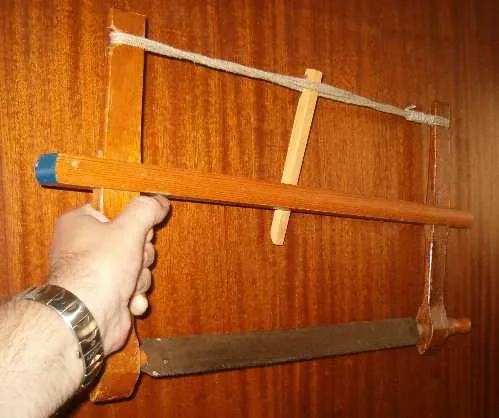
Making the Frame
Days one through three: plane the birch arms and pine stretcher, chop the stretcher mortises at mid-arm for a loose pivoting fit, shape the arms from square at the mortise to rounded grips, turn or carve the handles and slot them for the blade, make the toggle, and wind the cord. Then tension the blade and check it runs true.
- 4 min
- 7 steps
- 2 questions
- Lesson 143 of 204
In this lesson
- Stock
- Mortise and stretcher
- Shape the arms
- Handles and blade
- Toggle and cord
- True it up
- Try it
Picking up where you left off.
Stock
Plane two birch arms and a pine stretcher square and true. The Norwegian Forest Museum saw has a stretcher of knot-free pine 87.3 cm long and 3.9 by 2.6 cm in section, and birch arms 45 cm long 1; scale them to your blade. North House’s tool list (hand plane, 1-inch and 1/2-inch chisels, mallet, mortise gauge, sloyd knife, fine saw) is all this needs 2.
Mortise and stretcher
The stretcher’s ends sit in mortises at about the middle of each arm 1, or just above the midline 3.
- Mark the mortise centered on each arm’s width, at mid-length or a little above.
- Gauge it about a third of the arm’s thickness wide and chop it through from both faces.
- Cut a tenon on each end of the stretcher to fit, not glued and a little loose, so the arms can rock on it. On one museum saw the tenons are wedged inside the mortise 1; at home, a snug fit that still pivots is the goal.
Quick check
The stretcher is the fulcrum of two levers.
Shape the arms
Old Norwegian arms are rectangular in section, thickest at the mortise, and rounded toward the blade end to make grips; the tops are notched or grooved to hold the cord 1. Shape them with saw, knife, and plane:
- Taper each arm from full width at the mortise toward both ends.
- Round the lower third into a comfortable grip.
- Chamfer all edges.
- Cut a shallow notch across the top end for the cord.
Handles and blade
The blade hangs at the bottom of the arms in two handles that pass through round holes in the arms, slotted to take the blade, which is fixed with a pin or rivet; some museum handles are octagonal so the blade angle can be set and held 1. North House’s optional ⅝- and ¾-inch bits and turning chisel point to turned handles 2.
- Bore a hole through the bottom of each arm.
- Turn (or knife-carve) a handle with a shank that fits the hole, a shoulder, and a knob.
- Saw a slot in the shank end for the blade.
- Cross-drill for a pin that passes through the slot and the blade’s end hole. Blackburn’s blades have 3/16-inch holes and it sells blade holders and pins 4.

Quick check
Some museum saws have octagonal handles to hold set angles.
Toggle and cord
Make the toggle from a hardwood slat about 22 to 26 cm long, the size of the museum examples 1. Wind the cord in several loops around the notches at the tops of the arms (Tools for Working Wood uses about four loops of braided line 3), tie it off, slip the toggle between the strands at the middle, and twist. As the cord twists, the arm tops draw together and the blade tightens. Rest the toggle’s end against the stretcher to keep it from unwinding 1.
True it up
Tension until the blade pings when plucked. Sight down the blade: it must lie in the same plane as the frame, not twisted, or it will wander in the cut. Adjust by turning the handles slightly. Make test cuts along and across the grain.
Playback is optional. If the player is unavailable, open the video at its source.
Try it
Make the toggle-and-cord mechanism first with two scrap sticks and a dowel before you shape the arms. Feeling the leverage as the cord twists shows how much tension the arms and mortises must carry.
Lesson complete
Nice work.
Sources for this lesson
- 1Sag (frame saw SJF.14035). Norsk Skogmuseum, DigitaltMuseum. verifiedStretcher 87.3 cm, 3.9 x 2.6 cm, knot-free pine; birch arms 45 cm; blade 3.3 cm wide with raked teeth about 4 mm apart; octagonal handles; toggle 25.5 cm; stretcher ends sit in mortises in the arms. Twisting the cord with the toggle draws the arm tops together and pushes the bottoms apart, tensioning the blade. Other museum saws: stretchers 65-97 cm, arms 32-45 cm, blades 2.5-3.6 cm wide, about 60-70 cm toothed length, rip teeth about 5-7 tpi and finer blades 8-10 tpi.
- 2Traditional Tools: Frame Saws. North House Folk School. verifiedFour days (May 9-12, 2027), instructor Roald Renmælmo; tuition $495, materials $180. Students make an old Norwegian-style frame saw of pine and birch shaped with traditional hand tools, with a custom blade from Verktøysmia in Norway, and learn to sharpen and maintain it. Required tools: hand plane, 1 in and 1/2 in chisels, mallet, sloyd knife, mortise gauge, fine saw; optional saw-sharpening tools, turning chisel, 5/8 and 3/4 in bits, sharpening kit, scraper.
- 3Bow Saw Design. Tools for Working Wood. verifiedNotes on bow-saw design: cheeks, a stretcher just above the midline, a swinging toggle, about four loops of braided line for tension.
- 4Danish Frame Saw Parts. Blackburn Tools (Isaac Smith). verified1095 spring-steel frame-saw blades, 3/16 in holes: 1 1/4 x 16 in x 0.025 in, 9 ppi, for tenons and ripping to 1 1/2 in ($17 unsharpened, $51 sharpened); 1 1/4 x 24 in x 0.028 in, 7 ppi, for large tenons and ripping to 3 in ($21, $56). Stainless blade holders, bolts and pins $15; braided cord; suggests arms of elm, ash, hickory, or beech and a stretcher of pine, cedar, or basswood.