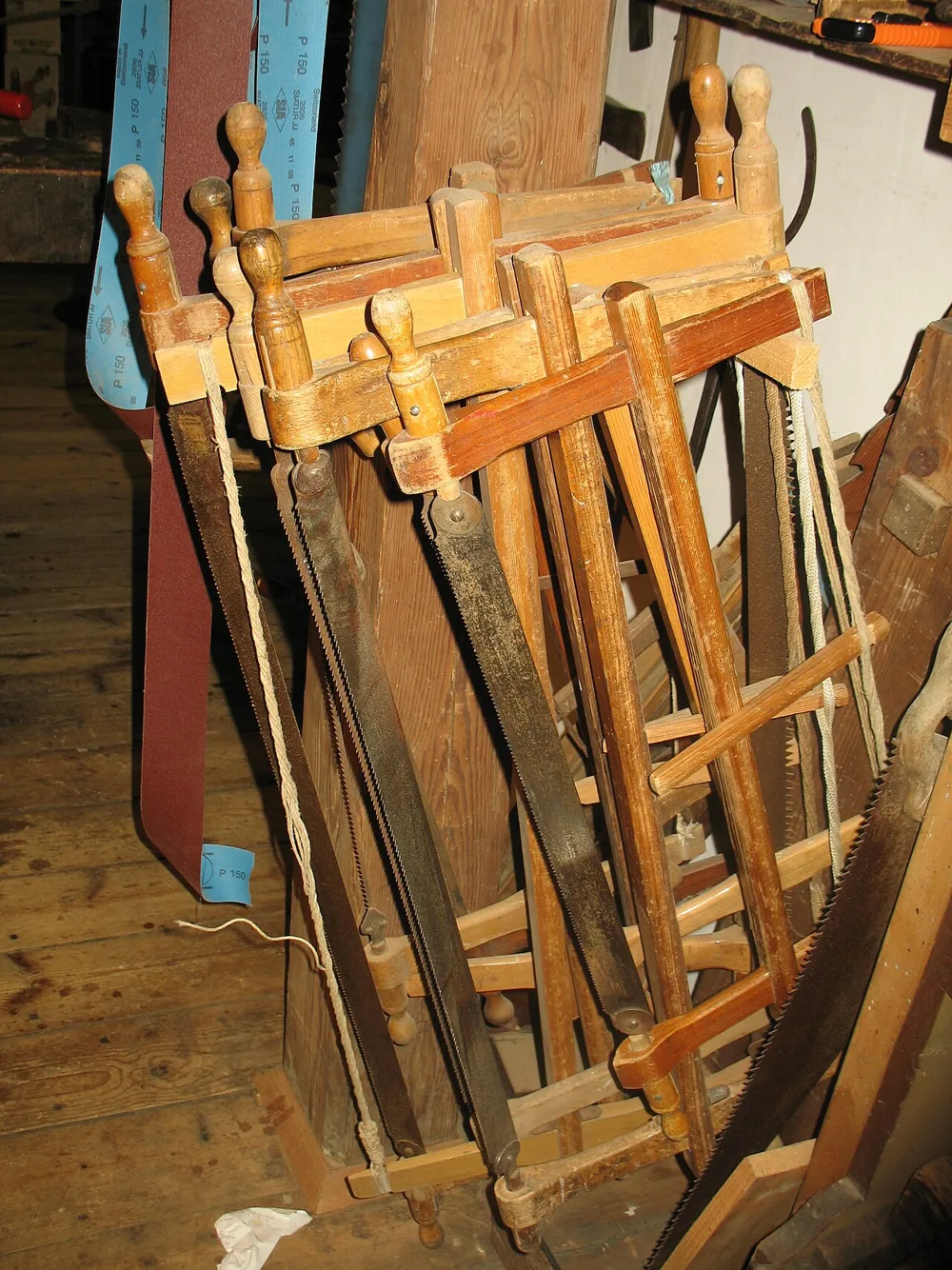
The Norwegian Frame Saw and What to Buy
Roald Renmælmo's four-day North House class makes an old Norwegian-style frame saw of pine and birch with a hand-made Norwegian blade. How a frame saw works, measurements from saws in Norwegian museums, where to buy resharpenable blades and hardware in the US, the wood, and a four-day plan.
- 3 min
- 6 steps
- 2 questions
- Lesson 142 of 204
In this lesson
- Why a frame saw
- How it works
- Blades
- Wood
- Try it
Picking up where you left off.
What you need
| Have it | Material | Spec | Qty | Where to get it |
|---|---|---|---|---|
| Frame-saw bladeBlackburn’s 24-in, 7 ppi blade, or an E.C. Emmerich 700 mm blade from Highland; avoid hardened ‘turbo’ blades that can’t be filed. | Resharpenable spring steel, 24 in (600-700 mm), 1 1/4-1 1/2 in wide, 5-9 teeth per inch | 1 (a rip blade first; a crosscut later) | Blackburn Tools (Isaac Smith) | |
| Alternative blade optional | E.C. Emmerich 700 mm, 38-40 mm wide, 5 tpi rip or 9 tpi rip-joinery | 1 | Highland Woodworking | |
| Blade holders and pins | Slotted holders with cross pins, or make handles and use 3/16 in steel pins | 1 set | Blackburn Tools (Isaac Smith) | |
| Arm stock | Straight-grained birch (or ash, beech, hickory), about 1 1/8 x 1 3/4 in | Two pieces about 18 in (45 cm) | Hardwood dealer, or rived from a log | |
| Stretcher stock | Knot-free pine (or spruce, cedar, basswood), about 1 x 1 1/2 in | One piece about 34 in (87 cm) | Lumberyard | |
| Handle stock | Birch, about 1 1/4 in square | Two pieces about 5 in | Offcuts | |
| Cord | Hemp, linen, or braided synthetic line | About 15-25 ft | Hardware store; or braided line from Blackburn | |
| Toggle | A hardwood slat about 10 in (25 cm) | 1 | Offcut |
Tools
Checkmarks are saved on this device.
The plan
-
Day 1
Stock and mortises
- Rive or saw and plane the birch arms and the pine stretcher
- Gauge and chop the stretcher mortises at mid-arm
- Cut the stretcher tenons to a sliding, unglued fit
-
Day 2
Shape the arms and make handles
- Taper and round the arms; notch the tops for the cord
- Turn or carve the handles; bore the arms
- Slot the handles for the blade and drill for pins
-
Day 3
Assemble and tension
- Make the toggle; wind the cord
- Fit and tension the blade; check it runs true
- Test cuts, rip and crosscut
-
Day 4
Sharpen and maintain
- Joint, shape, set, and file the teeth
- Side-dress the blade so it tracks
- Care and storage
This module reconstructs North House Folk School’s four-day Traditional Tools: Frame Saws, taught by Roald Renmælmo of NTNU in Norway. Students make “their own frame saw, based on an old Norwegian style of saw,” with a frame “built from pine and birch and shaped with traditional hand tools” and “a custom blade made by Verktøysmia in Norway,” and spend time “learning to sharpen and maintain the blade” 1. The class’s own plan isn’t published; this follows Norwegian museum saws and the sources cited.
Why a frame saw
Renmælmo describes making a frame saw (grindsag) as “a fine small project for a course of a few days.” When good frame-saw blades became hard to find in Norway, smith Jon Dahlmo of Verktøysmia started making blades suited to the Norwegian tradition, the blades North House students receive 2. Verktøysmia doesn’t sell in the US, so the blades below are substitutes.
How it works
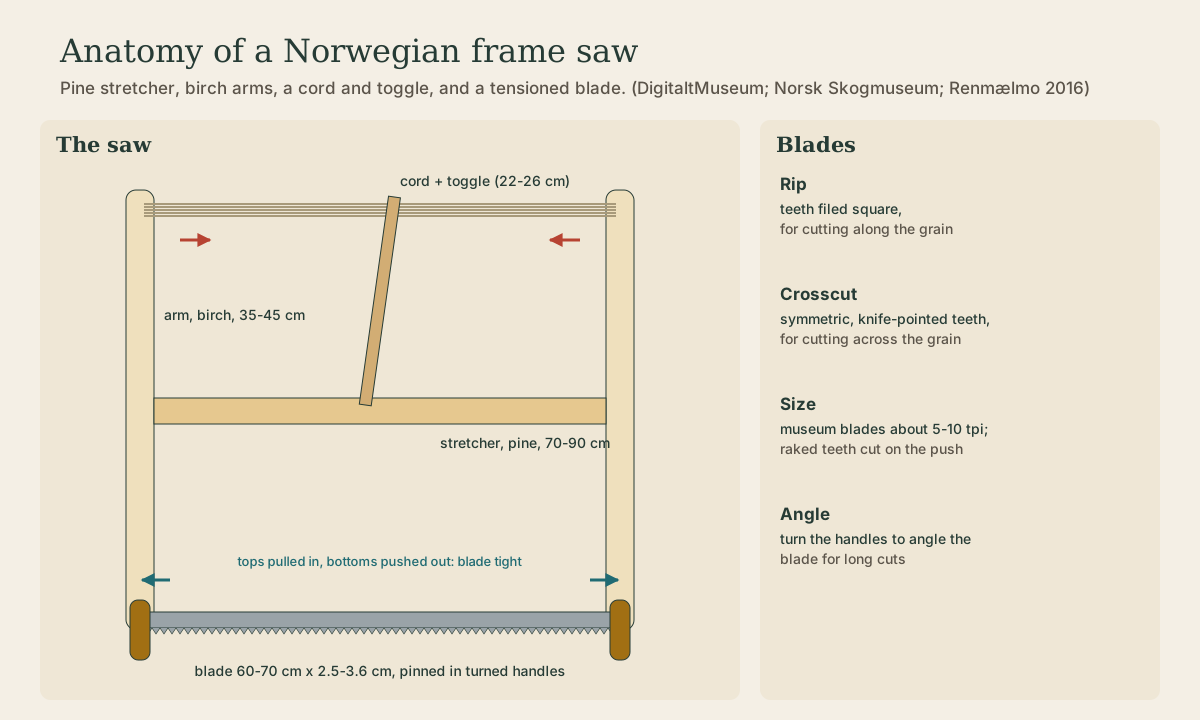
A frame saw has four parts: two arms, a stretcher between them, a blade across the bottom, and a cord across the top with a toggle. The stretcher’s ends sit in mortises at about the middle of each arm, loose, so the arms pivot. Twisting the cord with the toggle pulls the tops of the arms together, which pushes the bottoms apart and tensions the blade 3. Tools for Working Wood describes the same arrangement: a stretcher just above the midline and about four loops of line 4.
Measurements from Norwegian museum saws. A saw at the Norwegian Forest Museum has an 87-cm knot-free pine stretcher, 3.9 by 2.6 cm, 45-cm birch arms, a blade 3.3 cm wide, and a 25.5-cm toggle; other museum saws have stretchers of 65 to 97 cm, arms of 32 to 45 cm, and blades 2.5 to 3.6 cm wide and about 60 to 70 cm long 3.

Quick check
The stretcher is the fulcrum; the arms are levers.
Blades
Buy a blade you can resharpen, because sharpening is half the class:
- Blackburn Tools sells 1095 spring-steel frame-saw blades: 1 1/4 by 24 inches at 7 points per inch for large tenons and ripping up to 3 inches, or 16 inches at 9 ppi for finer work, plus blade holders and pins 5.
- Highland Woodworking sells E.C. Emmerich 700-mm blades, 38 to 40 mm wide, in 5 tpi rip, 9 tpi rip-joinery, or 4 tpi crosscut, all resharpenable 6.
Avoid impulse-hardened “turbo” blades: they cut well until dull and then can’t be filed.
Quick check
Impulse-hardened ‘turbo’ blades are throwaways.
Try it
Before buying wood, decide your blade length; it sets everything else. Lay the blade on the bench and sketch the saw full size around it: the arms stand at the blade’s ends with the handles, the stretcher runs between them at mid-height, and the cord crosses the top.
Lesson complete
Nice work.
Sources for this lesson
- 1Traditional Tools: Frame Saws. North House Folk School. verifiedFour days (May 9-12, 2027), instructor Roald Renmælmo; tuition $495, materials $180. Students make an old Norwegian-style frame saw of pine and birch shaped with traditional hand tools, with a custom blade from Verktøysmia in Norway, and learn to sharpen and maintain it. Required tools: hand plane, 1 in and 1/2 in chisels, mallet, sloyd knife, mortise gauge, fine saw; optional saw-sharpening tools, turning chisel, 5/8 and 3/4 in bits, sharpening kit, scraper.
- 2Roald Renmælmo. Sagblad og sagmaking. Høvelbenk (blog). 2016. verifiedFebruary 25, 2016. A December 2015 seminar group built frame saws (grindsager); good frame-saw blades had become hard to buy, and Jon Dahlmo of Verktøysmia began making blades suited to the Norwegian tradition. Making a frame saw is a fine small project for a course of a few days.
- 3Sag (frame saw SJF.14035). Norsk Skogmuseum, DigitaltMuseum. verifiedStretcher 87.3 cm, 3.9 x 2.6 cm, knot-free pine; birch arms 45 cm; blade 3.3 cm wide with raked teeth about 4 mm apart; octagonal handles; toggle 25.5 cm; stretcher ends sit in mortises in the arms. Twisting the cord with the toggle draws the arm tops together and pushes the bottoms apart, tensioning the blade. Other museum saws: stretchers 65-97 cm, arms 32-45 cm, blades 2.5-3.6 cm wide, about 60-70 cm toothed length, rip teeth about 5-7 tpi and finer blades 8-10 tpi.
- 4Bow Saw Design. Tools for Working Wood. verifiedNotes on bow-saw design: cheeks, a stretcher just above the midline, a swinging toggle, about four loops of braided line for tension.
- 5Danish Frame Saw Parts. Blackburn Tools (Isaac Smith). verified1095 spring-steel frame-saw blades, 3/16 in holes: 1 1/4 x 16 in x 0.025 in, 9 ppi, for tenons and ripping to 1 1/2 in ($17 unsharpened, $51 sharpened); 1 1/4 x 24 in x 0.028 in, 7 ppi, for large tenons and ripping to 3 in ($21, $56). Stainless blade holders, bolts and pins $15; braided cord; suggests arms of elm, ash, hickory, or beech and a stretcher of pine, cedar, or basswood.
- 6Bow Saw / Frame Saw Blades. Highland Woodworking. verifiedE.C. Emmerich 700 mm blades, 38-40 mm wide, holes 675 mm apart, 9 tpi rip-joinery, 5 tpi rip, or 4 tpi rough crosscut, resharpenable, from $20; 600 mm blades from $17.