White Oak, the Right Tree, and What You Need
North House's six-day white oak basket class starts from a log. Who teaches it and in what tradition, why white oak, how to choose the one tree in many that will split into basket splints, when you can cut an oak in Wisconsin without spreading oak wilt, the tools to buy or make, and a six-day plan.
- 3 min
- 6 steps
- 2 questions
- Lesson 128 of 204
In this lesson
- The tradition
- Why you start from a tree
- Choosing the tree
- Tools
- Try it
Picking up where you left off.
What you need
| Have it | Material | Spec | Qty | Where to get it |
|---|---|---|---|---|
| White oak logNo one sells hand-split white oak commercially; you start from the tree. | Quercus alba, 4-8 in diameter, straight, no limbs or knots for 5-7 ft, straight bark ridges | One 5-6 ft bolt (estimate: enough for several small baskets) | Your own woodlot, a landowner's thinning, a logger, or a consulting forester | |
| Natural dye materials optional | Black walnut hulls or bark, butternut bark, yellowroot; or walnut hull powder | A few handfuls of bark, or 50-100 g powder | Gathered, or a natural dye supplier | |
| Heavy leather padCovers your thigh while you scrape splints over it. | Vegetable-tanned leather scrap, about 12 x 14 in | 1 | Leather supplier or scrap bin | |
| Waxed linen or cotton string optional | A small ball, for tying rims while you lash | Craft store |
Tools
Checkmarks are saved on this device.
The plan
-
Day 1
The tree and the first splits
- Choose and fell the tree (or start from a fresh bolt)
- Split into halves, quarters, and eighths
- Remove bark and heartwood; dress billets on the shaving horse
-
Day 2
Splints
- Split billets along the growth rings into thin splints
- Scrape every splint over the knee
- Sort by width into stakes and weavers; coil; start the long dye pots
-
Day 3
Dye and the base
- Short dye baths; dry and re-soak
- Weave the filled rectangular base
- Upset the stakes
-
Day 4
Off
- North House’s schedule has a rest day here; let tired hands recover
-
Day 5
Sides and handle
- Weave the sides row by row and pack them
- Shave and bend the handle; dry it on a form
-
Day 6
Top and rim
- Finish the rows; trim and tuck the stakes
- Shave and scarf the rims
-
Day 7
Lash and finish
- Fit rims, rim filler, and handle
- Lash, crossing in an X at the handle
- Trim and admire
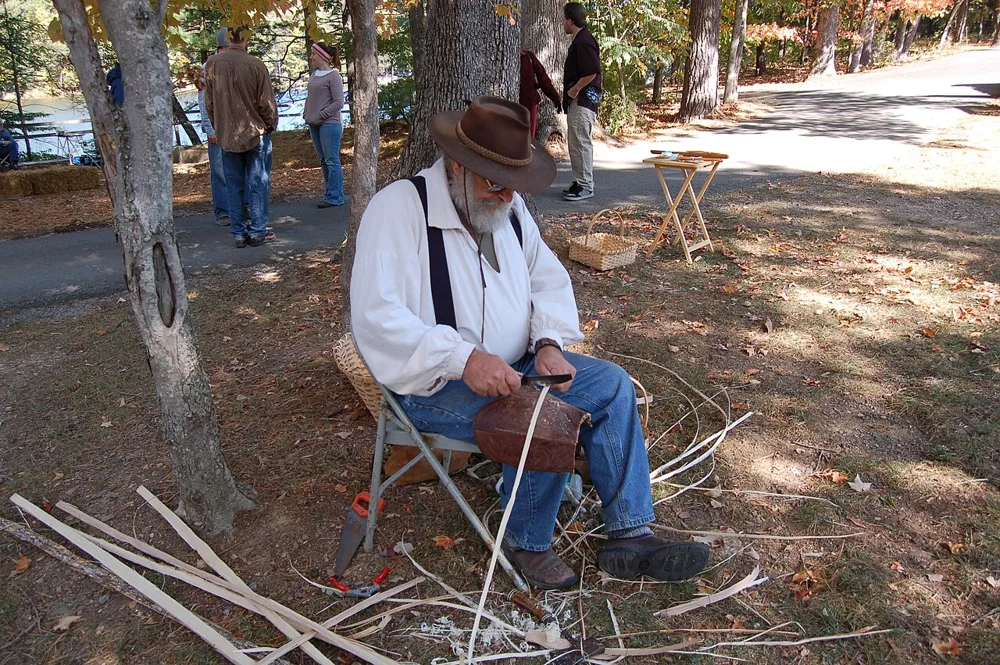
This module reconstructs North House Folk School’s six-day White Oak Basketry class. Students start “from the log,” splitting, cutting, and scraping their own white oak splints, may color some with natural dyes, and weave “a sturdy, long lasting basket” in horizontal plain weave, about 5 by 10 by 6 inches, with an optional handle. The tool list is short: a sloyd or carving knife, scissors, and “a piece of leather to cover your leg for scraping splint” 1. North House publishes no lesson plan; this is a reconstruction from the description and the sources cited, and the dimensions and cut list are estimates.
The tradition
The instructor, Mary W. Thompson of Cherokee, North Carolina, is an enrolled member of the Eastern Band of Cherokee Indians and a third-generation basketmaker who learned from her mother, Geraldine Wolfe Walkingstick, and her grandmother, Annie Welch 2. White oak basketry is shared by Cherokee and Appalachian makers, and a well-made white oak basket “can last 70 years or more” 3.
Playback is optional. If the player is unavailable, open the video at its source.
Why you start from a tree
The USDA says it plainly: “There is no commercial source of hand-split white oak” 3. Suppliers sell sawn or machine-processed strips, which don’t split along the growth rings and don’t behave the same. So a white oak basket begins with finding the right tree.
Choosing the tree
The best basket tree is a white oak (Quercus alba):
- 4 to 8 inches across, “with straight ridges on the bark” and a clear, straight midsection of 5 to 6 feet 3. Tennessee makers look for a sapling 4 to 6 inches across, “absolutely straight and unmarred by limbs, knots, or imperfections for at least … seven feet” 4.
- Minimal taper, and worked promptly after felling, or kept underwater until you’re ready 5.
Expect to be picky. One Ozark basketmaker, looking over a grove of 15 suitable-looking trees, takes only 6 or 7 6.
When to cut. Basket makers cut in late fall or early spring 7. In Wisconsin there’s a second reason to cut late: to avoid spreading oak wilt, the DNR says not to cut or wound oaks from April 1 to July 15 in the southern zone (April 15 to July 15 in the north) in or near oak-wilt areas 8. Late fall or winter satisfies both.
_(4072114499).jpg)
Quick check
Makers often reject most trees in a grove to find one that splits clean.
Quick check
Late fall or winter is also the traditional time to cut basket oak.
Tools
The splitting tools are the same as for any riving: a froe with a blade 6 to 10 inches long and at least 3/8 inch thick, a maul or club, iron wedges and wooden gluts, and a brake, a forked log or lashed poles that holds a split while you lever it apart 5. Then a drawknife on a shaving horse, a very sharp knife, and the leather pad for scraping. North House’s blog describes the small extras basketmakers use, like packing tools and clips 9.
Try it
Walk a woodlot in late fall and look at every white oak between 4 and 8 inches across. Note how many have straight bark ridges and no branches for six feet. Finding one good tree is the first skill of the class.
Lesson complete
Nice work.
Sources for this lesson
- 1White Oak Basketry. North House Folk School. verifiedSix-day course (Oct 6-12, 2026, with a day off for Basket Week's Gathering Day), instructor Mary W. Thompson, $670 tuition plus $220 materials. Starting from the log, students split, cut, and scrape their own white oak splints, may use natural dyes, and weave a horizontal plain-weave basket about 5 x 10 x 6 inches with an optional handle. Tools: sloyd or carving knife, scissors, leather to cover the leg when scraping; optional packing tool and clips.
- 2Mary Thompson (instructor). North House Folk School. verifiedEnrolled member of the Eastern Band of Cherokee Indians and third-generation basketmaker from Cherokee, NC, who learned from her mother Geraldine Wolfe Walkingstick and grandmother Annie Welch; works white oak, rivercane, and natural dyes.
- 3M. G. Thomas, D. R. Schumann. Weaving and Dyeing Materials (Agriculture Information Bulletin 666, ch. 15). USDA Forest Service, Forest Products Laboratory. 1997. verifiedThe ideal basket white oak is 4-8 inches in diameter with straight ridges on the bark and a clear, straight midsection of 5-6 feet. A white oak basket can last 70 years or more. There is no commercial source of hand-split white oak; suppliers sell sawn or processed strips.
- 4Roy M. Overcast Jr.. Basketmaking. Tennessee Encyclopedia. verifiedWhite oak basketmakers choose a sapling 4-6 inches in diameter, straight and free of limbs, knots, or imperfections for at least seven feet; a 6-9 ft section is barked, split into eighths, the heartwood cut out, and splits stripped by lining up a pocketknife blade with the growth rings.
- 5Drew Langsner. The tools and techniques to rive wood. Fine Woodworking (#12, 1978; republished 2026). 1978. verifiedFor basketry use white oak 5-8 inches in diameter with minimal taper; work it promptly after felling or keep the log underwater; bolts no longer than 5-6 ft; good stock cleaves to less than 1/16 inch. Froe 6-10 inch blade at least 3/8 inch thick with a handle 1.5-2 times the blade; 6-16 lb maul, iron wedges, wooden gluts, a club, and a riving brake. To steer a split that runs off, turn the piece and bear down harder on the thicker side. Below about 1/2 inch switch to a knife: start the cleft at a corner, twist it open, then pull apart with both thumbs using the knuckles as a fulcrum. Smooth with spokeshave, scraper, or knife.
- 6Eileen Jones. White Oak Basketry of the Ozarks. Smithsonian Center for Folklife and Cultural Heritage. 2023. verifiedOctober 16, 2023, on Billy Owens: from a grove of 15 suitable trees, makers take only 6-7.
- 7White Oak Baskets (from Bittersweet). Appropedia. verifiedFrom the Lebanon, Missouri, school folklore magazine Bittersweet (maker Lyn Marble). Logs 4-5 ft long and 4-5 inches in diameter, cut in early spring or late fall. A small round-handled basket: bottom strips 24 in long and 1/2-3/4 in wide; side weavers 4 ft long, 3/4-1 in wide; rims two pieces 1 in x 4 ft; lashing 1/8-1/4 in x 4 ft; handle 2 ft, 1/8-1/4 in thick, 3/8 in wide, from bark-side wood. Soak dried splints overnight. Lashing passes under the rims and through the gap beside each stake, crossing in an X at the handle, the end pushed back through the first two wraps.
- 8Oak Wilt. Wisconsin Department of Natural Resources. verifiedTo avoid spreading oak wilt, don't cut or wound oaks from April 1 to July 15 in the South Zone (April 15 to July 15 in the North) in or near oak-wilt areas.
- 9Ty Sheaffer. Open Secrets: Tools for Basket Making. North House Folk School blog. 2025. verifiedJanuary 17, 2025. Basket-making tools including packing tools and clips.