The Mangle Board
The carved board used with a roller to smooth linen, given by young men as a courtship offer: size and form, the Mount Horeb board from Little Norway, and making one with chip carving, a horse handle, and paint.
- 4 min
- 6 steps
- 3 questions
- Lesson 23 of 204
In this lesson
- What it was for
- A courtship gift
- The Mount Horeb board
- Making one
- Try it
- What to take from this
Picking up where you left off.
What it was for
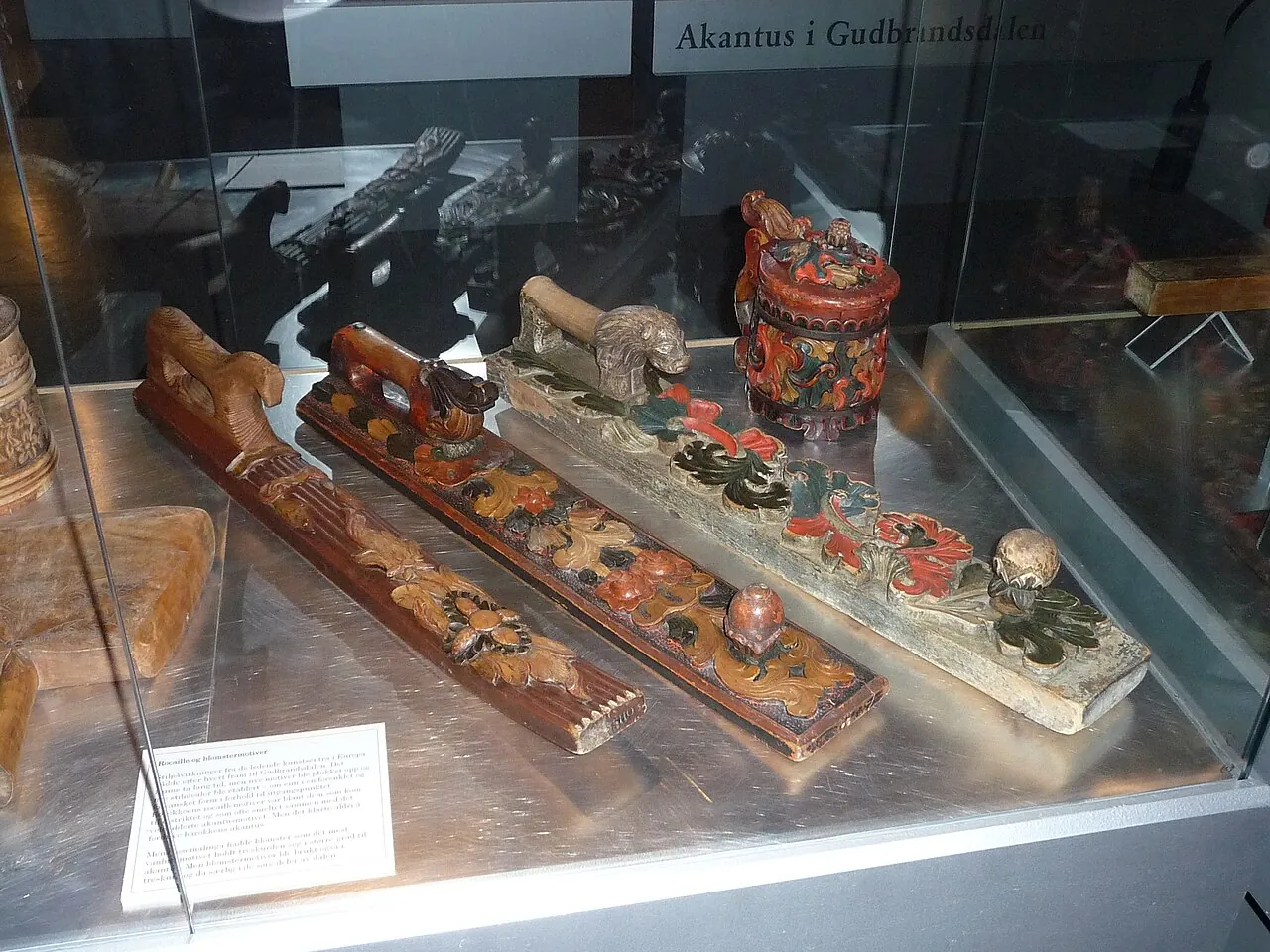
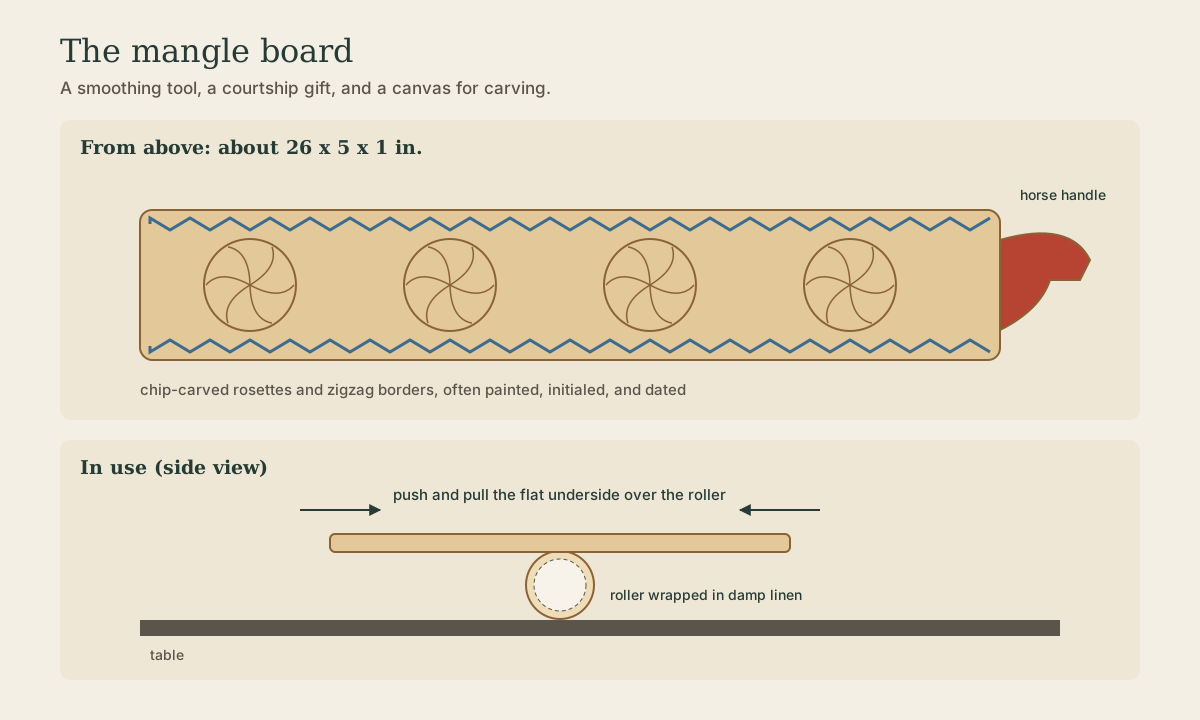
A mangle board is a pressboard used with a rolling pin to smooth wrinkles from linen 1. Damp linen was wound tightly around the roller, and the board’s flat underside was pushed and pulled over it on a table. The tradition spread across Scandinavia and northern Europe; the earliest known example is dated 1544, from Frisia in the Netherlands 1.

Boards were usually birch, beech, or oak, about 5 in. wide, 26 in. long, and 1 in. thick: flat and plain underneath for pressing, carved and painted on top, with a handle for balance 1.
Quick check
Only the top was carved; the bottom stayed flat to press the cloth.
Quick check
Usually birch, beech, or oak, with a handle at one end.
A courtship gift
Young men carved mangle boards as courtship proposals. If the young woman took the board inside, the courtship was on; if she left it outside, it wasn’t 1. The folk warning: beware of the man with many mangle boards 1.
That’s why so many are lavishly carved, initialed, and dated: they were a showpiece of skill and intent as much as a tool.
Quick check
Left outside, the board meant no.
The Mount Horeb board
Ann Smart Martin’s students at UW-Madison studied a painted mangle board now at the Mount Horeb Historical Society, displayed for more than 80 years at Little Norway in Blue Mounds 1. It shows two swans facing each other, a church with a stork, heart-shaped leaf plants, an angel, and a couple, with zigzag borders and a horse-shaped handle, painted orange, green, yellow, red, and blue; its maker, origin, and even its date remain uncertain 1.
Playback is optional. If the player is unavailable, open the video at its source.
Making one
- Stock: a straight-grained board of birch, maple, or basswood about 5 x 26 x 1 in., with extra length at one end for the handle.
- Handle: saw a horse, or a simple loop or knob, on the end. Carve it in flat planes and round the gripping part.
- Lay out the top: rosettes with a compass, borders of triangles and zigzags with a ruler, a space for initials and the year.
- Chip carve the geometry with a chip knife (see Chip Carving in Green Woodworking). Carve the border first, then the rosettes.
- Keep the bottom flat and smooth; it’s the working face.
- Finish: oil, or paint the background and leave the carving natural, or paint the chips in rosemaling colors.
Try it
Make a 26-in. birch mangle board with a horse handle, a chip-carved border, two rosettes, and your initials and the year. Use it with a dowel to smooth a damp linen towel and see how well it works.
What to take from this
A mangle board smoothed linen wound on a roller; it’s about 5 x 26 x 1 in., flat underneath and carved on top, with a handle. Young men carved them as courtship offers, accepted if the board went inside. Make one with a sawn and carved handle, a chip-carved top, and a flat working face.
Lesson complete
Nice work.
Sources for this lesson
- 1Ann Smart Martin. The Mystery of the Mount Horeb Mangle Board. Creators, Collectors, and Communities (LibreTexts). verifiedMangle boards smoothed linen over a roller; earliest known example 1544 in Frisia; birch, beech, or oak, about 5 x 26 x 1 in.; flat underside, carved top with a handle; given as courtship gifts; a painted board with swans, a church, and a horse handle at the Mount Horeb Historical Society, long shown at Little Norway.