The Dala Horse
The carved and painted horse of Dalarna: whittled toys recorded from 1623, the villages around Lake Siljan, the two-colors-on-one-brush painting, the 1939 World's Fair that made it Sweden's symbol, and carving and painting your own.
- 4 min
- 6 steps
- 3 questions
- Lesson 19 of 204
In this lesson
- From toy to symbol
- The shape
- Carving one
- Painting
- Try it
- What to take from this
Picking up where you left off.
From toy to symbol
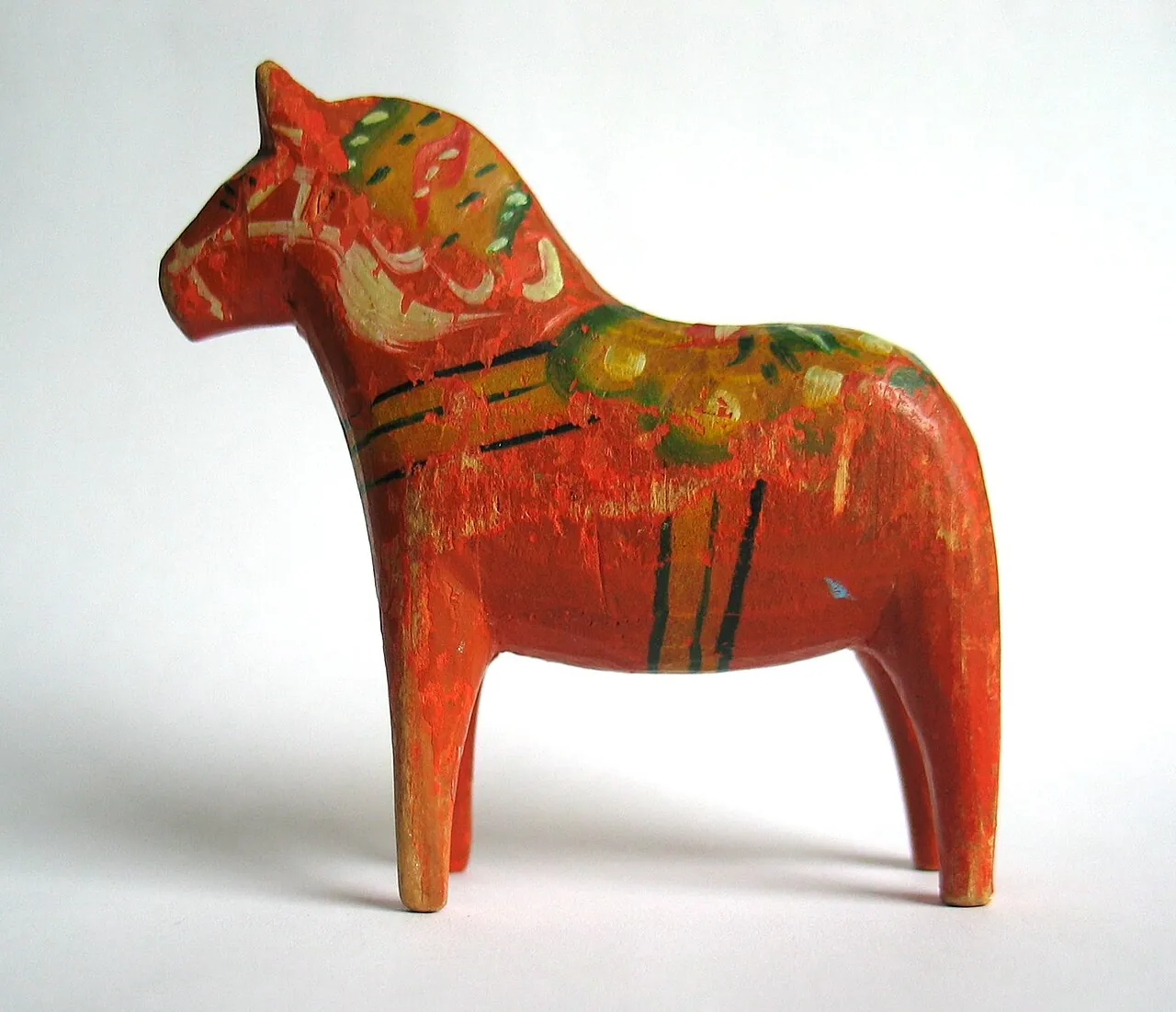
The Dala horse (dalahäst) is a carved and painted wooden horse from Dalarna in central Sweden. Wooden horses for sale are recorded as early as 1623, and production concentrated in four villages: Bergkarlås, Risa, Vattnäs, and Nusnäs 1. The early horses were plain whittled toys; painting arrived in the 19th century, borrowing from the region’s furniture painting 1.

The 1939 New York World’s Fair turned it into a symbol of Dalarna and of Sweden in general 1. Nusnäs is still the center: Grannas A. Olssons Hemslöjd has made them since 1922 1.
Quick check
Before that it was a regional toy from Dalarna.
The shape
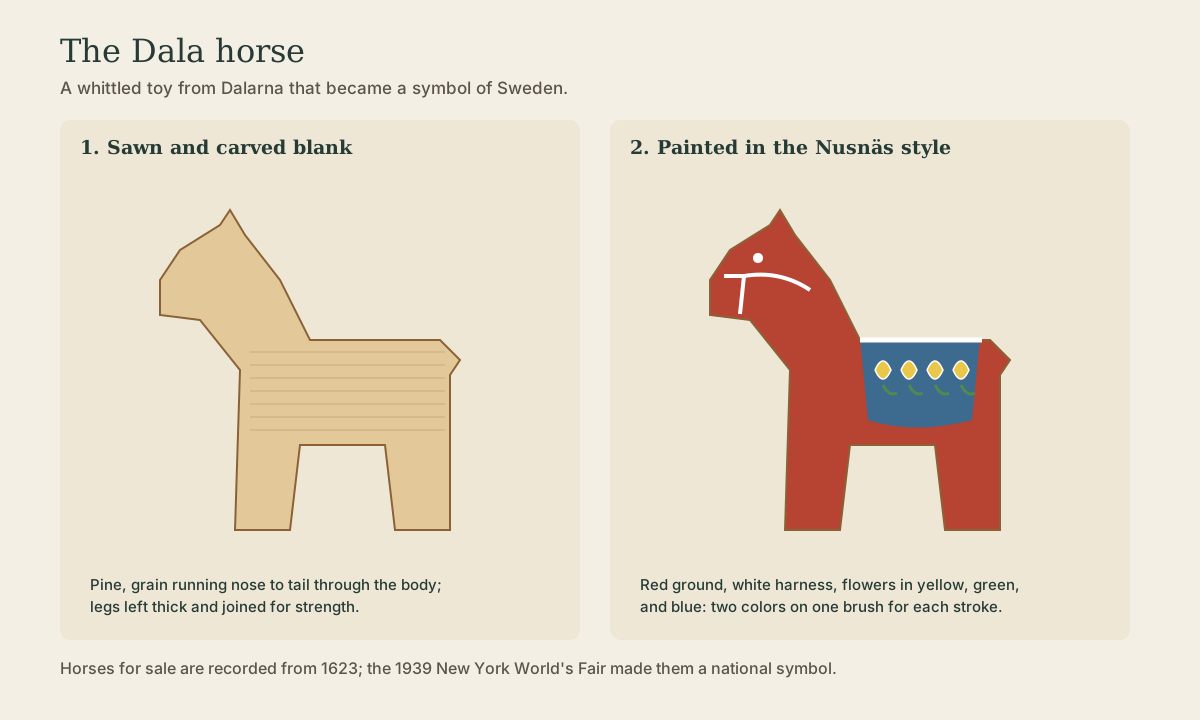
The Dala horse is carved in a stout flat-plane style 1: an arched neck, a squared muzzle, a short tail, and legs left thick and joined in front and back blocks, with a gap under the belly. The joined legs aren’t just style; they make a toy that survives being dropped.
Carving one
Modern Nusnäs horses are handmade from slow-grown pine from around Lake Siljan, and at least nine artisans work on each one: carving, priming, filling cracks, sanding, painting, and varnishing 1. At home:
- Blank: pine or basswood, about 1-1/4 in. thick. Lay the pattern with the grain running nose to tail through the body.
- Saw the profile with a coping saw or bandsaw, including the belly gap.
- Carve the corners off with a knife in flat planes: bevel the back and belly, taper the neck and head, chamfer the legs. Keep it chunky.
- Smooth lightly if you want the Nusnäs look (they sand before painting), or leave the facets for a folk-carving look.
Playback is optional. If the player is unavailable, open the video at its source.
Quick check
Pine from around Lake Siljan; at least nine people handle each horse.
Painting
- Ground: the horses were first painted iron-oxide red; red-orange with harness details in white, green, yellow, and blue is the classic scheme 1. Black, blue, white, and natural are common too.
- Harness and saddle: a white bridle and noseband, a saddle cloth, and kurbits-style flowers.
- Two colors on one brush: load one side of a flat brush with one color and the other side with another, then make each stroke so it shades from light to dark. Stikå Erik Hansson introduced the technique, still used today 1. Practice on paper first.
- Finish with varnish or oil.
See Rosemaling and Kurbits and Earth Pigments in the Traditional Paints course for the painting tradition behind the flowers.
Quick check
Stikå Erik Hansson is credited with introducing it.
Try it
Saw and carve a 5-in. Dala horse from pine, paint it red with milk paint or acrylic, then paint a white harness and a saddle cloth with three two-color flowers.
What to take from this
Dala horses began as whittled toys in Dalarna villages, recorded from 1623, were painted from the 19th century, and became Sweden’s symbol after the 1939 New York World’s Fair. Carve them stout from pine with the grain nose to tail and the legs joined, paint a red ground with a white harness, and paint flowers with two colors on one brush.
Lesson complete
Nice work.
Sources for this lesson
- 1Dala horse. Wikipedia. verifiedCarved wooden toy from Dalarna; wooden horses for sale recorded from 1623; villages Bergkarlås, Risa, Vattnäs, and Nusnäs; painted from the 19th century, first in iron-oxide red; two colors on one brush introduced by Stikå Erik Hansson; 1939 New York World's Fair made it a national symbol; Grannas A. Olssons Hemslöjd founded 1922; pine, at least nine artisans per horse.