Soap Day the Old Way: Lye from Ashes
Before lye came in cans, families made it by running water through a barrel of wood ashes. An 1897 Connecticut Valley housekeeping book describes the whole year: fat scraps saved in a soap-grease barrel, the ash leach set up in spring, the egg test for strength, and a long soap day boiling grease and lye in a six-pail kettle until it turned thick and ropy.
- 4 min
- 6 steps
- 3 questions
- Lesson 114 of 204
In this lesson
- The soap-grease barrel
- The ash leach
- Soap day
- Why we use store lye now
- Try it
Picking up where you left off.
The Pocumtuc Housewife, published in Deerfield, Massachusetts, in 1897 “by several ladies,” was written for young wives new to the Connecticut Valley. Along with its recipes, it gives “plain directions for soap-making” as the old valley households did it 1.
The soap-grease barrel
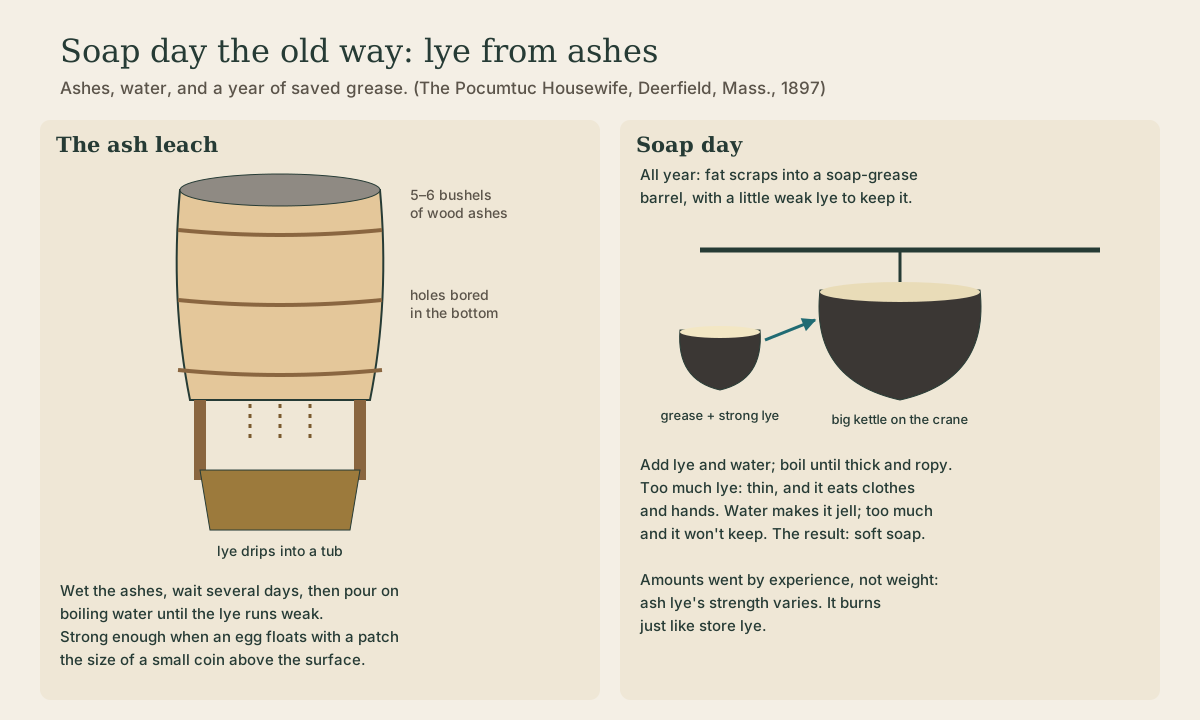
Soap day started a year ahead. Keep a soap-grease barrel in the cellar with some weak lye in it, and drop in bacon rinds, bits of fat meat, the fat skimmed from boiled salt meat, darkened cake fat, “and everything fat that comes along.” The lye works on it and keeps it from spoiling. “It is amazing how much comes along in the course of a year” 1.
The ash leach
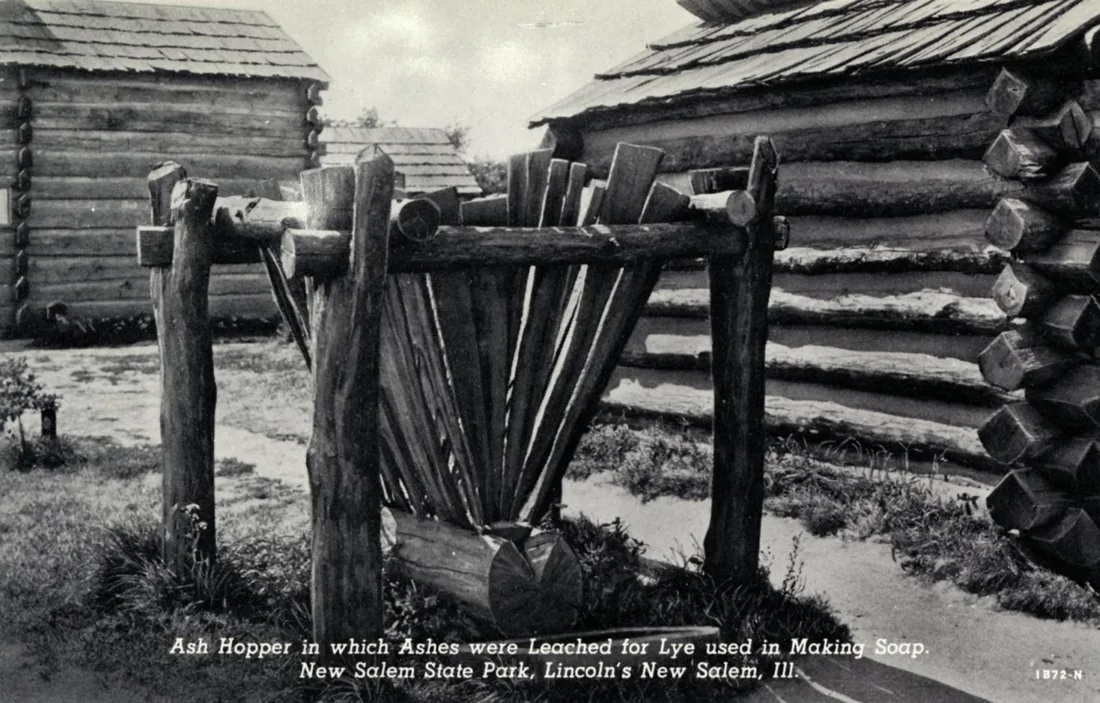
In spring, when the ash hole was cleaned out, five or six bushels of wood ashes went into the ash leach. Without one, a hogshead, a big barrel, with holes bored in the bottom and set up on sticks would do 1:
- Pour on enough water to wet the ashes thoroughly, but not so much that they drip, and let them stand several days.
- Then pour on boiling water and let it drip into a tub. Keep adding water until the lye coming out grows weak.
- Test the strength: if the lye is strong enough to hold up an egg so that a patch about the size of a ninepence coin shows above the surface, “it is about right.”
Quick check
Pour until the lye runs weak.
Quick check
The book’s coin was a ninepence.
Soap day
On soap day, get breakfast out of the way early and plan an easy dinner. Swing the big six-pail kettle on the crane over the fire, and heat the grease with some strong lye in a smaller kettle. As the grease dissolves, ladle it into the big pot, adding more lye and water. “A little experience will teach how much of each.” Too much lye makes the soap thin, and it “will eat your clothes and your hands.” Water makes it jell, but too much and it won’t keep. Boil until it becomes thick and ropy 1.
If it doesn’t “come,” take out a little in a dish and try adding water, then lye, then grease, until the sample thickens; then add whatever it needed to the big pot and boil again 1. That was the old way to troubleshoot without a scale.
What came out of that kettle was a jellied soap, softer than the hard bars of the last lesson. The 1942 Michigan bulletin’s rescue method, boiling with water until it looks like honey, is essentially the same process 2.
Quick check
Water made it jell, but too much water and it wouldn’t keep.
Why we use store lye now
Ash lye is still caustic, and it burns skin and eyes just like store-bought lye 3. Its strength varies with the ashes and the water, which is why the old directions measured by eggs and experience instead of ounces 1. Weighed lye and the 1942 recipe’s measured fat make predictable soap. Make ash lye once to understand the old way, with goggles and gloves, and use it for a small kettle batch rather than hard bars.
Try it
Fill a bucket with holes drilled in the bottom with hardwood ashes from a wood stove, set it on bricks over a glass or enamel pan, and pour hot water through it. Try the old egg test on what drips out. Handle the liquid with gloves and goggles, as you would any lye.
Lesson complete
Nice work.
Sources for this lesson
- 1Several Ladies of Deerfield. The Pocumtuc Housewife: A Guide to Domestic Cookery as It Is Practiced in the Connecticut Valley. Willard Lend a Hand Society, Deerfield, Massachusetts. 1897. verifiedSoap making: keep a soap-grease barrel in the cellar with some weak lye, adding bacon rinds and fat scraps all year. In spring put five or six bushels of ashes in the ash leach, or a hogshead with holes bored in the bottom set up on sticks; wet the ashes without dripping, let stand several days, then pour on boiling water and let drip into a tub until the lye grows weak; strong enough when it bears up an egg with a piece as big as a ninepence showing. On soap day, a six-pail kettle on the crane; heat grease with strong lye in a smaller kettle and dip into the big pot, adding lye and water; too much lye makes it thin and the soap will eat clothes and hands; water makes it jell, but too much and it won't keep; boil until thick and ropy. Candle dipping: tow wicks for common candles, cotton for best; cut by winding around a board and running a knife across; six wicks per rod, doubled and twirled; dip in alum water to keep candles from running. Two poles across chair backs, a board under to catch drips, tallow melted in a brass kettle on the floor. First dip: straighten wicks and pinch the ends or the candle will be crooked. Dip two rods at a time with a quick slanting motion, long enough to take a coat but not melt the first. Keep the kettle full and hot by pouring in boiling water as the tallow lowers; if it cools the candles build faster but rough. Two dozen dippings; harden before slipping off rods; beeswax in the tallow makes them harden; bleach the best in a sunny window; molds for a few.
- 2Making Soap at Home (Extension Folder F-14, reprint). Michigan State College Extension Division. 1942. verifiedArchive copy; not current recommendations. 6 pounds of fat and 1 can of lye make 9 pounds of soap; fat from butchering makes excellent laundry soap; fryings can be clarified. Equipment: enamel, crockery, or glass utensils, wooden stick, household scales, wooden or heavy cardboard box lined with a wet cloth, thermometer. Clarifying fryings: boil with an equal amount of water, add 1 quart cold water per gallon, cool, lift off fat. Rendering: grind or cut fat, heat slowly in a little water, strain when cracklings settle. Mixed fats make the best soap; order: tallow and lard mixed, tallow, lard; poultry fat only combined with others. Cold process: 1 can lye (13 ounces), 1 quart cold water, 6 pounds fat, 3 tablespoons borax if desired. Temperatures: soft rancid fat 97-100 F with lye 75-80; sweet lard or soft fats 80-85 with 70-75; lard and tallow 100-110 with 80-85; tallow 120-130 with 90-95. Dissolve lye in cold water and cool; pour lye solution slowly into fat, stirring slowly and evenly, 20 or 30 minutes until it holds its shape; pour into box lined with cloth wrung out of cold water. Cut with knife or string or wire. Cure several weeks; aging completes the combining of lye and fat and dries the soap. Tongue test for neutral soap. Do not let new soap freeze. If it separates: melt with water to thick syrup, boil slowly until like honey, mold. Recommended for laundry and dishwashing.
- 3NIOSH Pocket Guide to Chemical Hazards: Sodium Hydroxide. National Institute for Occupational Safety and Health (CDC). verifiedIncompatibilities: water; acids; flammable liquids; organic halogens; metals such as aluminum, tin, and zinc; nitromethane. Exposure by inhalation, ingestion, skin or eye contact. Symptoms: irritation of eyes, skin, mucous membranes; pneumonitis; eye and skin burns. First aid: eye, irrigate immediately; skin, water flush immediately. Prevent skin and eye contact; provide eyewash and quick drench.