Green Timber, Species, and Grading
Frames are cut from green timber and designed for it; choose a species that works easily and stays stable, read the grade, and expect checks without fearing them.
- 5 min
- 7 steps
- 3 questions
- Lesson 45 of 204
In this lesson
- Why green
- Species
- Boxed heart vs. free of heart
- Grading
- Seasoning checks
- Ordering
- What to take from this
Picking up where you left off.
Why green
Most timber frames are cut from green timbers, still full of sap. Big timbers take years to dry, so drying first is impractical, and green wood cuts far more easily with chisels and slicks. The engineering reflects this: the Wood Handbook notes that for lumber thicker than 4 inches, design properties are typically assigned on the basis of green wood, with no adjustment for moisture 1.
Green framing has consequences you design for:
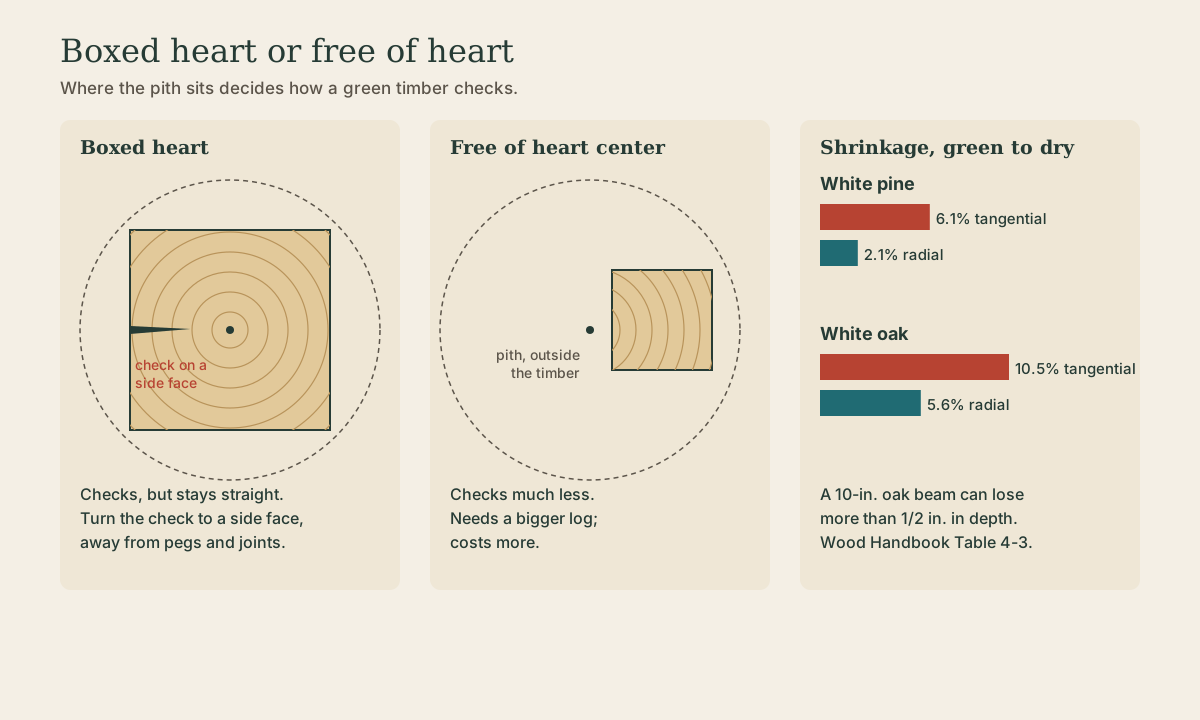
- Shrinkage. Timbers shrink across the grain as they dry, tangentially about twice as much as radially, and almost nothing in length 2. A 10-inch-deep oak beam can lose more than half an inch in depth.
- Checks. Seasoning checks open on the faces of boxed-heart timbers. They’re normal.
- Movement at joints. Joinery must tighten, not loosen, as wood shrinks; drawbored pegs and well-placed housings do that.
Quick check
The Wood Handbook notes that for lumber thicker than 4 inches, properties are usually assigned on the basis of green wood and not adjusted for moisture.
Species
What North House uses and why: the majority of its projects use eastern white pine, milled locally, because it’s easy to work and “excellent to use green as it remains fairly stable as it dries” 3. Its low shrinkage (6.1 percent tangential, 2.1 radial from green to dry) is why 2.
Common framing species in the Upper Midwest:
| Species | Notes |
|---|---|
| Eastern white pine | Easy to cut, stable, light; the folk-school standard |
| Red pine | Stronger than white pine, available in Wisconsin; more pitch |
| Eastern hemlock | Strong, cheap, can be splintery and prone to shake |
| Tamarack | Strong and decay-resistant; good for sills |
| White oak | Very strong and durable; heavy, hard to cut, shrinks a lot, checks |
| Red oak | Strong but not decay-resistant; keep it dry |
| Douglas-fir | Strong, stable, available long; shipped from the West |
Pegs are traditionally oak or another strong, straight-grained hardwood, riven or turned dry so they don’t shrink loose.
Boxed heart vs. free of heart
- Boxed-heart timbers contain the pith near the center. Every one will develop seasoning checks, typically one big check on a face, but they’re stable and stay straight.
- Free-of-heart-center (FOHC) timbers are sawn from bigger logs with the pith outside the piece. They check much less, but large logs are needed and they cost more.
Grading
Structural timbers are stress graded, mostly by visual grading: an inspector judges growth characteristics that reduce strength. The Wood Handbook lists the main criteria: knots, slope of grain, checks and splits, shake, density, decay, ring count and latewood, pitch pockets, and wane 1.
What matters most:
- Knots interrupt the grain. In a beam, knots on the bottom (tension) edge hurt bending strength most; knots near the centerline matter little.
- Slope of grain: grain running diagonally across a piece weakens it.
- Shake: separation between growth rings, which reduces shear strength in beams.
- Checks and splits: rated by the size of the actual opening.
Grades include Select Structural, No. 1, and No. 2, each with design values in the National Design Specification. If your building inspector requires it, North House notes that grade-stamped timbers and site-specific engineered plans can be provided 3. For a shed you may not need stamped timber; for a house you almost certainly will.
Seasoning checks
Checks alarm newcomers, but in a boxed-heart timber they’re expected. The Timber Frame Engineering Council has published a technical bulletin specifically on seasoning checks in timbers 4. Practical rules: orient a boxed-heart beam so the expected check is on a side face rather than the top or bottom edges, keep checks away from peg holes and joints where possible, and don’t fill them. Checks through joinery or along the bottom of a beam near midspan deserve a closer look.
Quick check
Checks are normal; don’t fill them, but watch any through joinery or near midspan at the bottom.
Ordering
Order timbers sawn to full dimension with extra length, from a mill that saws timbers; band-sawn timbers have a smooth, even surface. Ask for straight logs, boxed heart or FOHC as you prefer, and species and grade. Stack them stickered and shaded if they’ll wait more than a few days, and coat the ends to slow end checking.
What to take from this
Frames are cut green and designed for green timber: timbers over 4 inches carry green design values. Eastern white pine is the easy, stable folk-school choice; oak is strong but hard and shrinks more. Boxed-heart timbers check but stay straight. Grades depend mostly on knots, slope of grain, and shake; checks are expected and should be oriented to the side faces.
Practice
Knots and cross grain on the tension side of a beam reduce bending strength the most. Knots near the centerline matter little.
Lesson complete
Nice work.
Sources for this lesson
- 1Stress Grades and Design Properties for Lumber, Round Timber, and Ties (Wood Handbook, Chapter 7). USDA Forest Service, Forest Products Laboratory, FPL-GTR-282. 2021. verifiedHow structural lumber and timbers are graded and assigned design values. Cited at: Moisture Adjustments; Visual Sorting Criteria.
- 2Samuel V. Glass, Samuel L. Zelinka. Moisture Relations and Physical Properties of Wood (Wood Handbook, Chapter 4). USDA Forest Service, Forest Products Laboratory, FPL-GTR-282. 2021. verifiedFree and bound water, fiber saturation (~30%), EMC table (Table 4-2), green moisture by species (Table 4-1), shrinkage by species (Table 4-3), and the shrinkage equation. Cited at: Shrinkage; Table 4-3.
- 3Timber Frame: Build Your Own, Larger Frames FAQ. North House Folk School. verifiedMost frames use locally milled eastern white pine, worked green because it stays fairly stable as it dries; a 24×28 frame weighs about 15,000 pounds.
- 4Timber Frame Engineering Council Technical Bulletins. Timber Framers Guild. verifiedEngineering guidance including TFEC 1 design standard references, Rules of Timber Joinery Design (2011), Seasoning Checks in Timbers (2018), and Draw Boring of Pegged Joints (2020).