Making Linseed Oil Paint
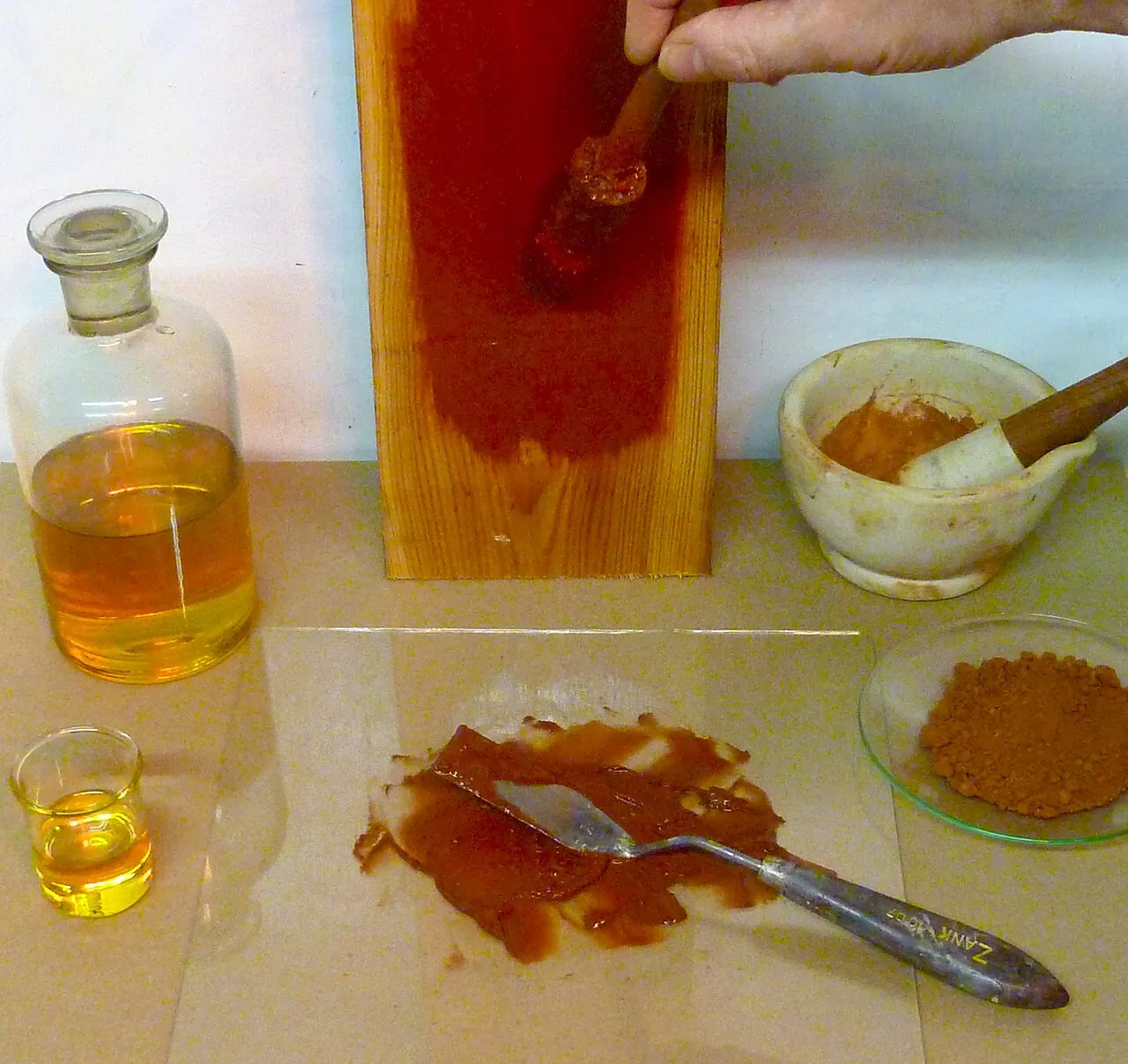
Linseed oil paint is just pigment dispersed in linseed oil - mulled to a paste on a slab and let down to brushing consistency - with no solvent needed and no lead allowed.
- 5 min
- 7 steps
- 3 questions
- Lesson 27 of 204
In this lesson
- What’s in it
- Choosing pigments
- Equipment
- The method
- Mixing by eye vs. by recipe
- Storing
- What to take from this
Picking up where you left off.
What’s in it
Traditional linseed oil paint has only two essential ingredients: linseed oil and pigment. Historically a solvent such as turpentine was added for easier spreading and white lead was the main white pigment 1, but neither is necessary. Modern Scandinavian linseed oil paints are made from purified, heat-treated linseed oil and inorganic pigments with no solvent at all, and the makers say not to thin them with solvent 2.

The Swedish National Heritage Board notes that linseed oil paint has been used on Scandinavian wooden buildings since the 17th century, first only for trim and details because the oil was expensive, and on whole facades by the early 1900s 3.
Choosing pigments
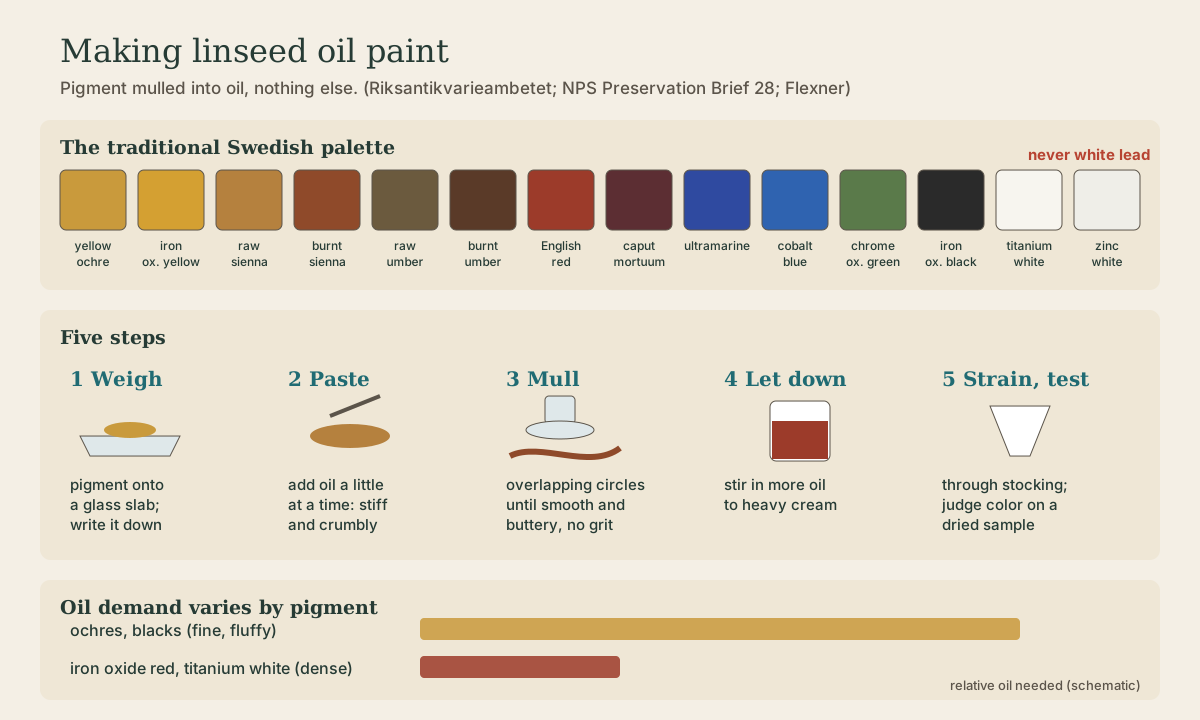
Use inorganic, lightfast pigments. The traditional Swedish palette documented by the National Heritage Board is a good starting list 3:
- Yellows: yellow ochre, iron oxide yellow.
- Earths: raw and burnt sienna, raw and burnt umber.
- Reds: English red, iron oxide red, caput mortuum (a deep violet-brown iron oxide).
- Blues: ultramarine, cobalt blue.
- Greens: chromium oxide green.
- Blacks: iron oxide black, bone black.
- Whites: titanium white and zinc white, never white lead.
Iron oxide pigments, natural and synthetic, are cheap, permanent, and safe to handle with ordinary care. Many traditional exterior paints include some zinc white, which makes a harder film. Avoid lead white, chrome yellow, and cadmium pigments for home use; they’re toxic, especially as dust.
Quick check
Lead white was the historic standard and is toxic, especially as dust.
Equipment
- A sheet of thick glass or a smooth stone slab.
- A glass muller (a flat-bottomed glass pestle) or, for small batches, a stiff palette knife.
- A scale, jars with tight lids, and a fine strainer or old nylon stocking.
- A dust mask for handling dry pigment.
The method
- Weigh the pigment and put a heap on the slab. Write down amounts: you’ll want to repeat the color.
- Add oil a little at a time and work it in with the palette knife until you have a stiff, crumbly paste. Different pigments take very different amounts of oil: fine, fluffy pigments like ochres and blacks need much more than dense ones like iron oxide red or titanium white.
- Mull it. Work the paste under the muller in overlapping circles, scraping it back into the middle with the knife, until it’s smooth and buttery with no grit or streaks of dry color. This is the important step: it breaks up clumps and wets every particle with oil, which is what gives even coverage 4.
- Let it down. Move the paste to a jar and stir in more linseed oil until it’s like heavy cream, brushable but not runny.
- Strain it, and test on a scrap: color changes as paint dries, and you want to see coverage on the actual wood.
For a larger batch, mull a concentrated color paste, then stir it into the bulk oil. Commercial pre-ground pigment pastes in linseed oil save the mulling entirely.
Which oil? Raw oil gives the slowest-curing, deepest-penetrating paint; boiled or heat-treated oil cures faster; a little stand oil makes a tougher film. Many traditional makers use heat-treated boiled oil without added driers. A small amount of drier can be added for cold-weather work.
Quick check
Dry pigment clumps. Mulling breaks up the clumps and coats each particle with oil, which gives smooth coverage and full color.
Mixing by eye vs. by recipe
Traditional painters mixed by eye and by feel. If you’re matching an old color or painting a whole house, work by weight: pigment and oil, recorded. Linseed paint colors shift a little as the film cures and yellows slightly, then bleaches back in sunlight, so judge color on a dried sample in daylight.
Storing
Linseed oil paint keeps for a long time. Store it in a full, tight jar, or pour a thin layer of oil on top to keep a skin from forming. Stir thoroughly before use; pigments settle.
What to take from this
Linseed oil paint is pigment mulled into linseed oil until every particle is wetted, then thinned with more oil to brushing consistency and strained. Use lightfast inorganic pigments such as iron oxides, earths, ultramarine, chromium oxide green, and titanium or zinc white; never white lead. No solvent is needed. Weigh and record your recipe and judge color on a dried test.
Practice
White lead was the historic standard but is highly toxic, especially as dust. Titanium and zinc whites replace it.
Lesson complete
Nice work.
Sources for this lesson
- 1Preservation Brief 28: Painting Historic Interiors. National Park Service, Technical Preservation Services. verifiedHistoric paint types - linseed oil paint with driers, whitewash, distemper, casein (milk) paint - and how linseed oil paint keeps cross-linking for decades. Cited at: Types of Historic Paints.
- 2Allbäck Linseed Oil Paint (product information). Lee Valley Tools. verifiedSolvent-free paint of boiled, purified linseed oil and inorganic pigments; about 24 hours to dry at room temperature and 50% RH, two to three times longer cold or damp; two to three coats outdoors.
- 3Kulturkulör: Traditional Swedish Colours. Swedish National Heritage Board (Riksantikvarieämbetet). verifiedLinseed oil paint on Scandinavian wooden buildings since the 17th century, and the traditional pigment palette - ochres, siennas, umbers, iron oxide reds, ultramarine, chromium oxide green.
- 4Bob Flexner. Understanding Wood Finishing: How to Select and Apply the Right Finish. 3rd revised ed. Fox Chapel Publishing. 2021. verifiedThe standard reference on finish chemistry and practice - drying oils and driers, shellac cuts, waxes, and what each finish can and can't do. Cited at: Pigments and Dyes.