Inkle and Band Looms
Weaving narrow warp-faced bands on an inkle loom: the continuous warp, heddled and open ends, warping a pattern of color, weaving and beating, simple patterns from warp color alone, pick-up, and what bands are for - straps, belts, trim, and ties.
- 3 min
- 4 steps
- 3 questions
- Lesson 71 of 204
In this lesson
- How it works
- Designing with warp color
- Weaving
- Uses
Picking up where you left off.
How it works
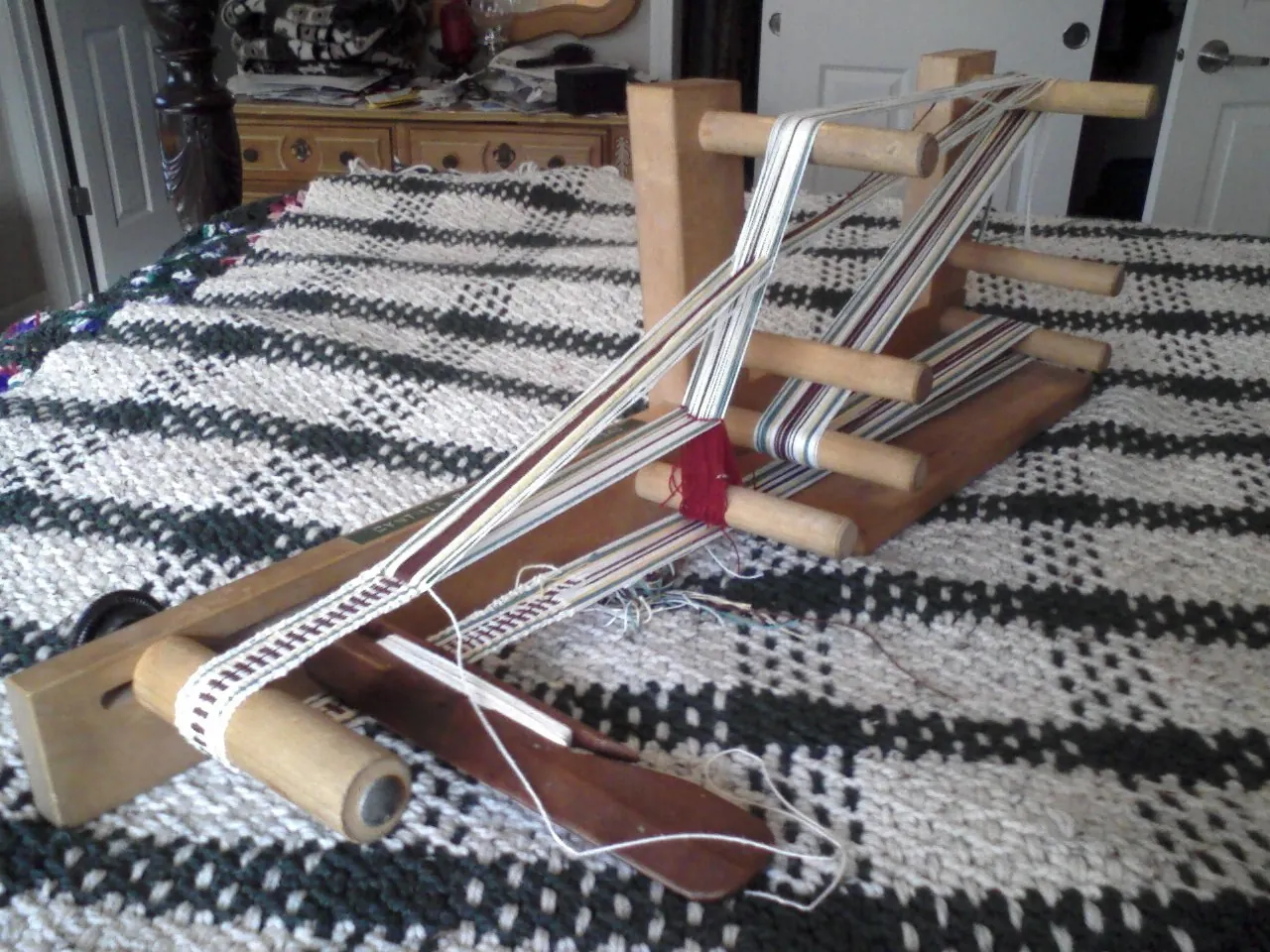
An inkle loom is a wooden frame with dowels around which a continuous warp runs in a loop 1. Alternate ends pass through string heddles fixed to a heddle bar; the ends between are open 1:

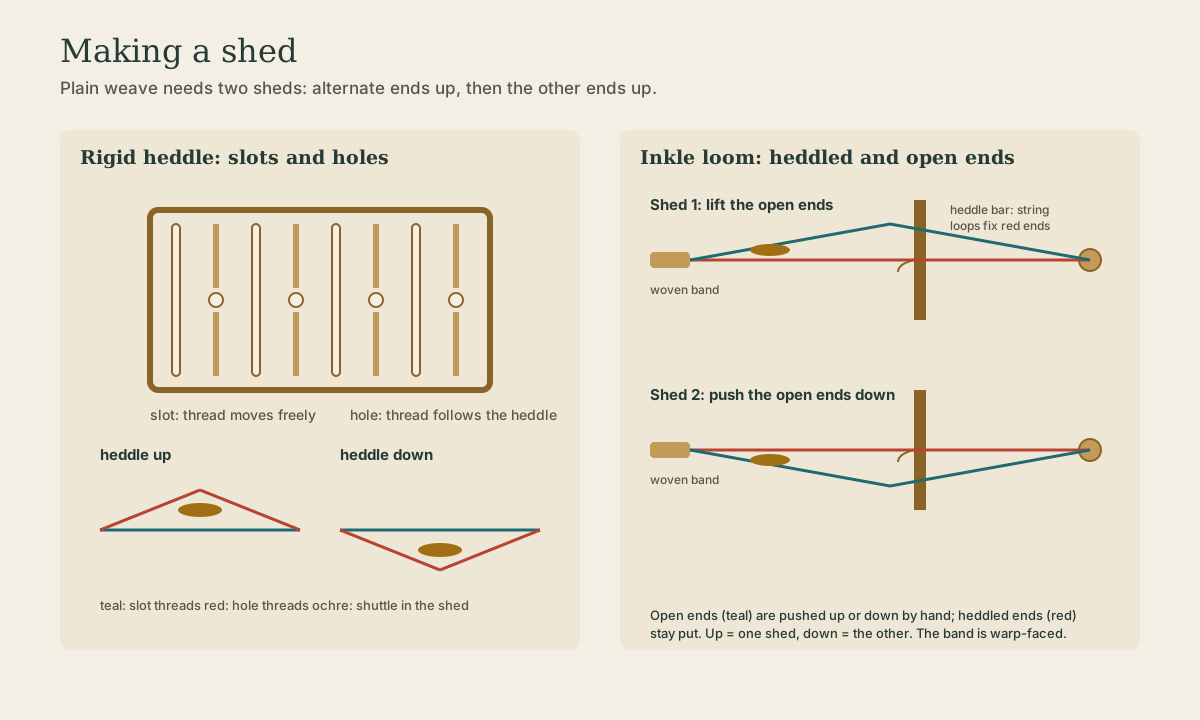
- Lift the open ends above the heddled ones: one shed.
- Push the open ends down below them: the other shed.
Pass a small belt shuttle (which doubles as a beater) through each shed, beat, and change 1. The finished band slides around the loop as you weave, so a warp can be several times longer than the loom.
“Inkle” once meant a linen tape, and Shakespeare mentions inkle three times 1.
Quick check
Open ends up is one shed, open ends down the other.
Quick check
Shakespeare mentions it three times.
Designing with warp color
Inkle bands are warp-faced: the warp packs so tightly that it hides the weft, which shows only as small bumps at the edges 1 2. So the design comes from the order of warp colors.
Draft a band as two rows of squares, the top row for heddled ends and the bottom for open ends, alternating:
| Warp plan | Result |
|---|---|
| all heddled one color, all open another | horizontal bars (alternating every pick) |
| a color in both heddled and open of the same position | a solid vertical stripe |
| alternating colors in pairs | small checks, “pebbles,” and dashes |
Warp with a fine, smooth, strong yarn - mercerized cotton (sizes 5/2 to 10/2), wool, or linen - and a weft of the same yarn as the edge color.
Quick check
So the pattern is designed by planning the warp colors.
Weaving
- Warp the loom following your draft, tying a heddle for every other end.
- Weave a few picks of scrap to spread the ends.
- Weave with an even tug on the weft at each edge: the weft sets the width, so pull to the same width every pick.
- Beat firmly with the shuttle’s edge.
- Advance the band around the loop as it nears the heddles.
Pick-up patterns lift individual ends out of their normal shed to float motifs - diamonds, letters, small figures - across the band 1. Supplementary weft brocade adds another way to decorate.
Uses
Camera and guitar straps, belts, bag straps, hatbands, dog leashes, trim for garments, and narrow shoelaces 1; in the past, garters, ties, and edgings on clothing.
What to take from this
An inkle loom carries a continuous warp; heddled ends stay put while open ends are lifted or pushed down for the two sheds. Bands are warp-faced, so the pattern comes from the warp color order, drafted as alternating heddled and open rows. Keep an even weft tug for a straight edge, beat firmly, and use pick-up for motifs.
Lesson complete
Nice work.
Sources for this lesson
- 1Inkle weaving. Wikipedia. 2026. verifiedContinuous warp on a framework of dowels; alternate ends held in heddles or left open to make two sheds; warp-faced bands and pick-up patterns; "inkle" once meant a linen tape.
- 2Weaving. Wikipedia. 2026. verifiedWarp and weft, shed, heddles, shafts, reed and beater; plain, twill, and satin weaves; warp-weighted, backstrap, and floor looms; sett, ends and picks per inch.