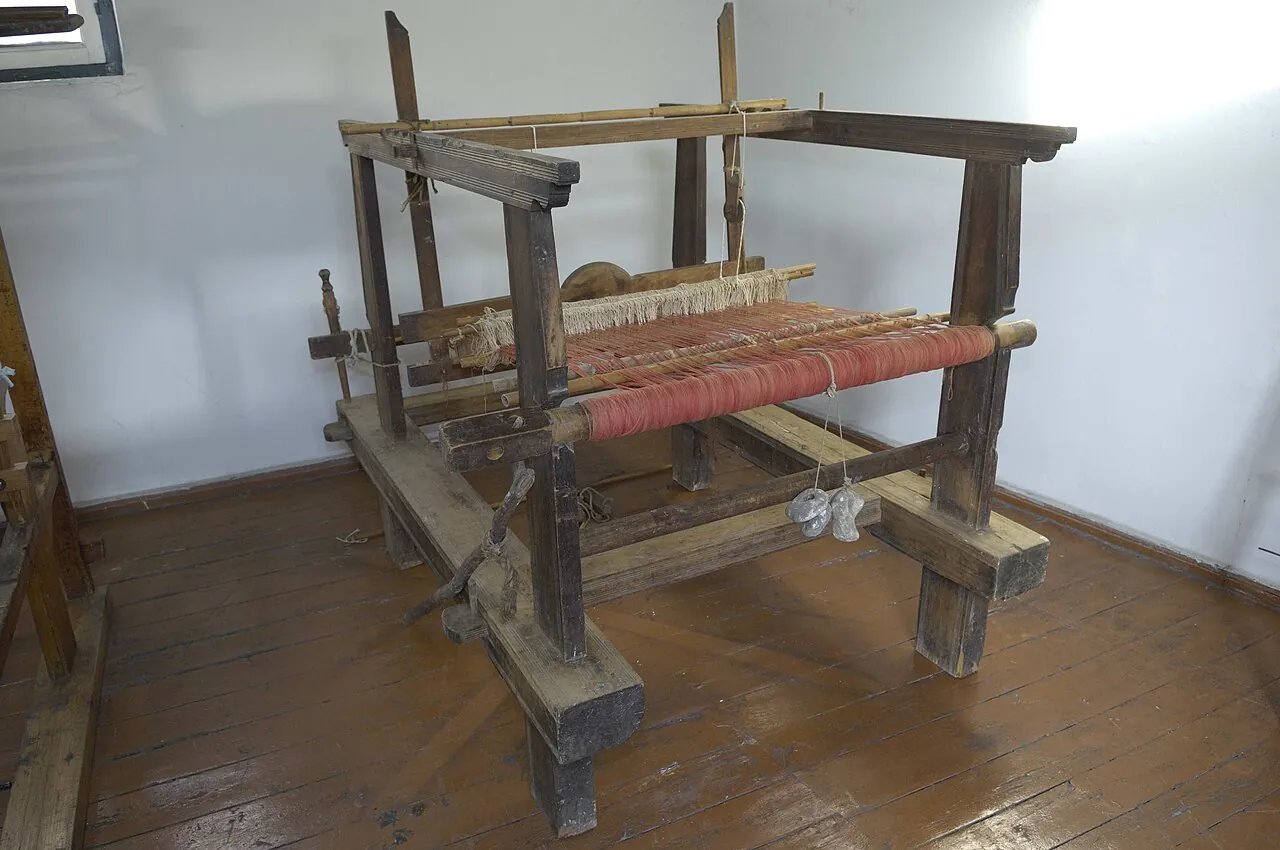
Floor Looms and Weaving Drafts
Multi-shaft looms and the drafts that run them: shafts, treadles, and jack, counterbalance, and countermarch actions; reading threading, tie-up, and treadling; working out a drawdown by hand; and the classic structures a four-shaft loom weaves - twills, overshot, and rosepath.
- 4 min
- 5 steps
- 3 questions
- Lesson 69 of 204
In this lesson
- Floor looms
- Reading a draft
- Working a drawdown
- What four shafts can weave
- What to take from this
Picking up where you left off.
Floor looms
Table and floor looms add shafts, usually four or eight, each carrying heddles. Threading each warp end through a heddle on a chosen shaft, then lifting combinations of shafts, makes any interlacing those shafts allow 1. Table looms lift shafts with levers; floor looms use treadles tied to shafts, leaving both hands free.

Three actions:
| Action | How the shed opens | Notes |
|---|---|---|
| Jack (rising shed) | treadled shafts rise; others stay | simple to tie up; common in North America |
| Counterbalance | shafts hang in pairs; some rise as others sink | traditional, smooth; best with balanced tie-ups |
| Countermarch | every shaft is actively raised or lowered | large clean sheds; the Scandinavian standard, more ties |
Quick check
Counterbalance sinks some shafts as others rise; countermarch actively raises and lowers each shaft.
Reading a draft
A draft is the recipe for a cloth, drawn on graph paper 2:
- Threading (across the top): each column is one warp end, each row one shaft; a mark shows which shaft that end goes on. Read right to left, starting at the tie-up 2.
- Tie-up (the corner): each column a treadle, each row a shaft; marks show which shafts each treadle lifts. The number of rows is the number of shafts needed 2.
- Treadling (down the side): each row one pick, each column a treadle; read top to bottom 2.
- Drawdown (the big grid): the cloth the other three produce.
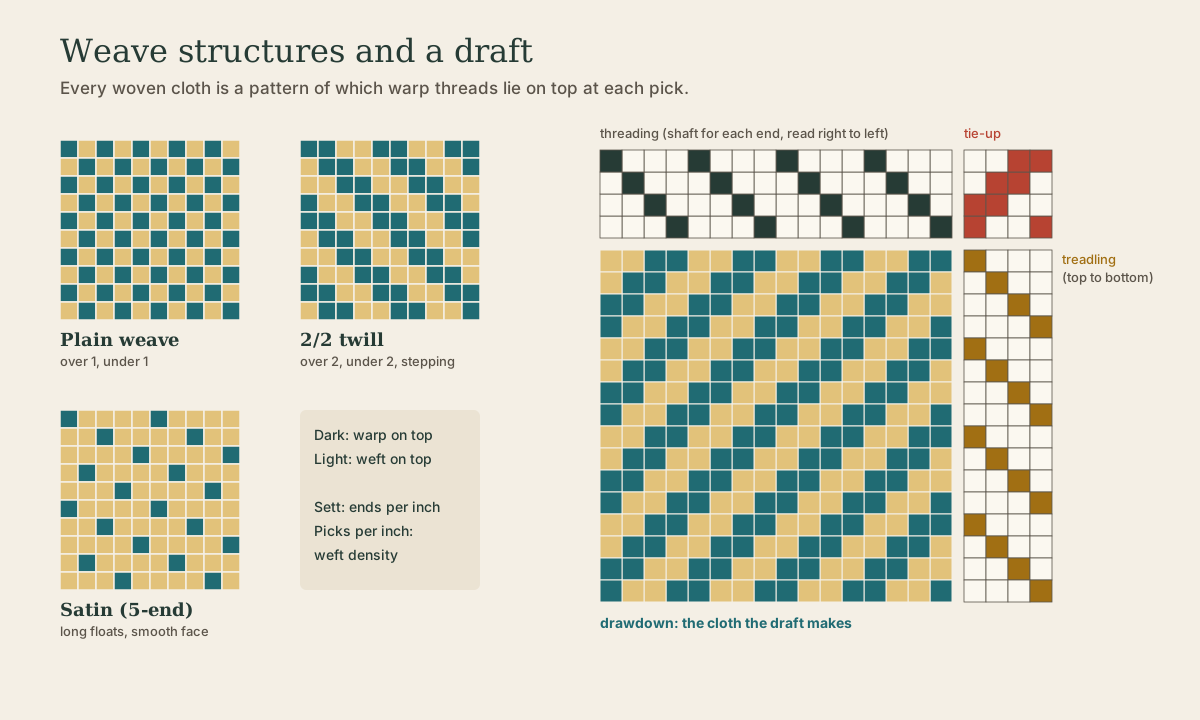
Conventions vary - European drafts may read from the other side or show sinking rather than rising shafts - so check a draft’s key.
Quick check
Its number of rows tells you how many shafts the draft needs.
Working a drawdown
To fill in one square of the drawdown:
- Look down the column to see which shaft that end is threaded on.
- Look across the row to see which treadle that pick uses.
- Check the tie-up: does that treadle lift that shaft?
- If yes, the warp shows (fill the square); if no, the weft shows.
Repeat for every square. Doing a small one by hand is the fastest way to understand drafts; weaving software does it instantly for real projects.
Quick check
That’s the draft in the diagram.
What four shafts can weave
- Twills: straight, broken, point (zigzag), herringbone, and bird’s-eye from different threadings and treadlings.
- Rosepath: a Swedish point-twill threading, treadled countless ways - a staple of Scandinavian rugs and runners.
- Overshot: pattern floats over a plain-weave ground, the classic American coverlet weave.
- Monk’s belt, huck lace, summer and winter, and many more.
Four shafts are enough for a lifetime of weaving; eight open up complex twills, double weave, and more.
What to take from this
Floor looms lift combinations of shafts (jack, counterbalance, or countermarch) with treadles. A draft gives threading (right to left), tie-up (shafts per treadle), and treadling (top to bottom); the drawdown fills a square with warp whenever that pick’s treadle lifts that end’s shaft. A straight 1-2-3-4 threading with a 2/2 tie-up makes twill; four shafts also weave rosepath, overshot, and more.
Lesson complete
Nice work.
Sources for this lesson
- 1Weaving. Wikipedia. 2026. verifiedWarp and weft, shed, heddles, shafts, reed and beater; plain, twill, and satin weaves; warp-weighted, backstrap, and floor looms; sett, ends and picks per inch.
- 2Lynn Rognsvoog. Learn to Read a Simple Multi-Shaft Draft. Handwoven. 2025. verifiedTie-up in the corner shows shafts per treadle; threading read right to left from the tie-up; treadling read top to bottom.