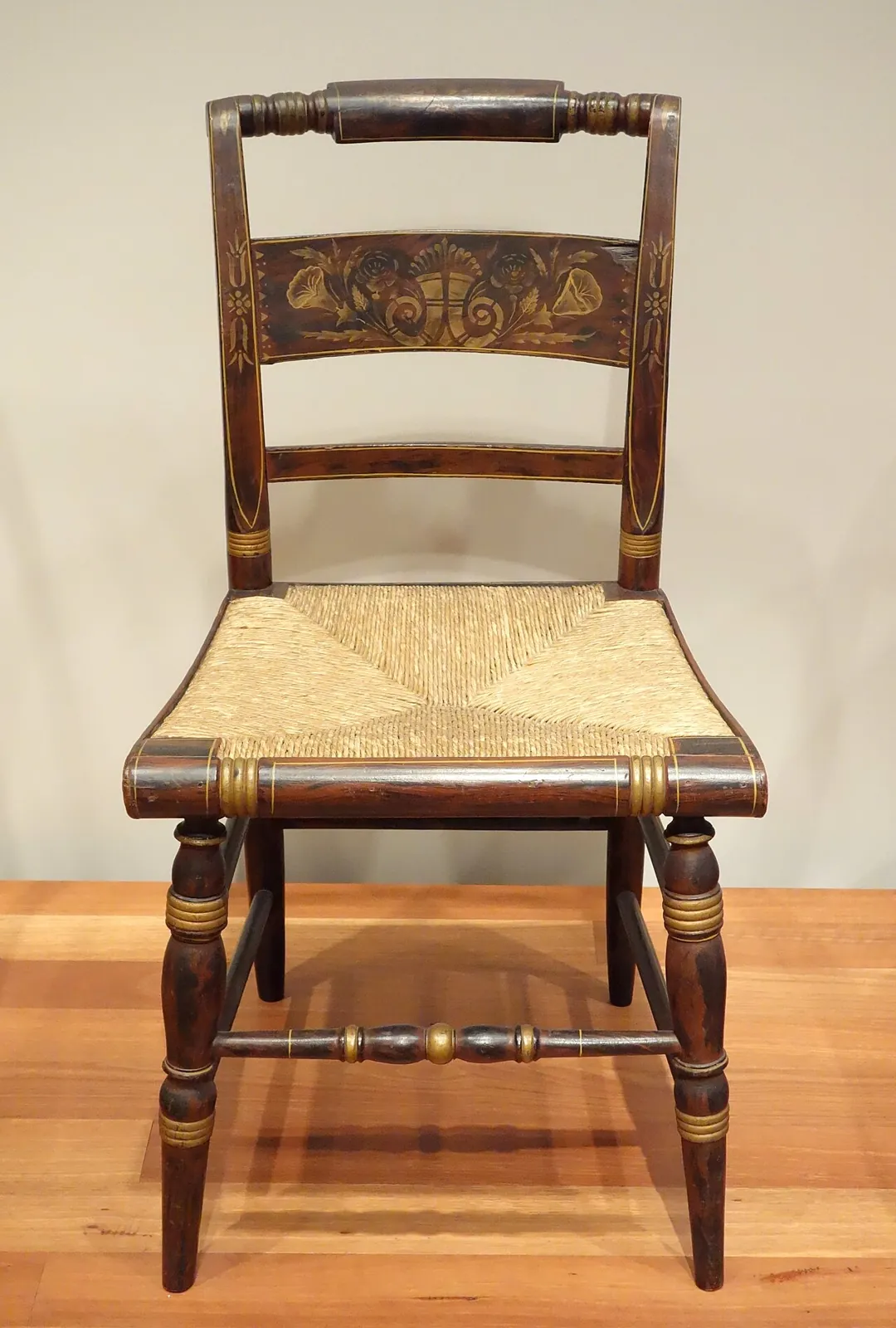
Rush Seats
Twisted cattail and paper fiber rush woven around the rails: gathering and drying cattail, soaking and twisting strands, the corner-to-corner wrap that builds four triangles, stuffing the pockets, filling the front corners of a tapered seat, and finishing a rectangle with figure-eights.
- 4 min
- 5 steps
- 3 questions
- Lesson 78 of 204
In this lesson
- Materials
- The weave
- Tapered and rectangular seats
- Finish
- What to take from this
Picking up where you left off.
Materials
“Rush” covers several stemmed and leafy marsh plants. Perry notes that cattail and flag, common across the northern states, serve as rush 1:
,_1826-1829,_painted_wood_and_woven_rush_seat_-_De_Young_Museum_-_DSC00816.JPG)
- Gathering: cut when full grown and still green, as the leaf tips begin to brown - about mid-August 1. Tie in loose bundles and dry in the shade, ideally a dark room, until thoroughly dry.
- Soaking: about ten hours in water before use, less in warm water 1.
- Twisting: cut off the coarse butt ends about a foot from the base. One leaf makes a fine strand, two medium, three coarse; twist tightly and always in the same direction, adding leaves top end first 1. Perry recommends one leaf for beginners.
Fiber rush - twisted kraft paper - is the common substitute: even, strong, and sold on spools. Dampen it by dipping, but never soak it, since it’s paper; it shrinks slightly as it dries, tightening the seat 1. Most chairs today are seated in fiber rush.
Quick check
Then dry the bundles in the shade and soak about ten hours before use.
The weave
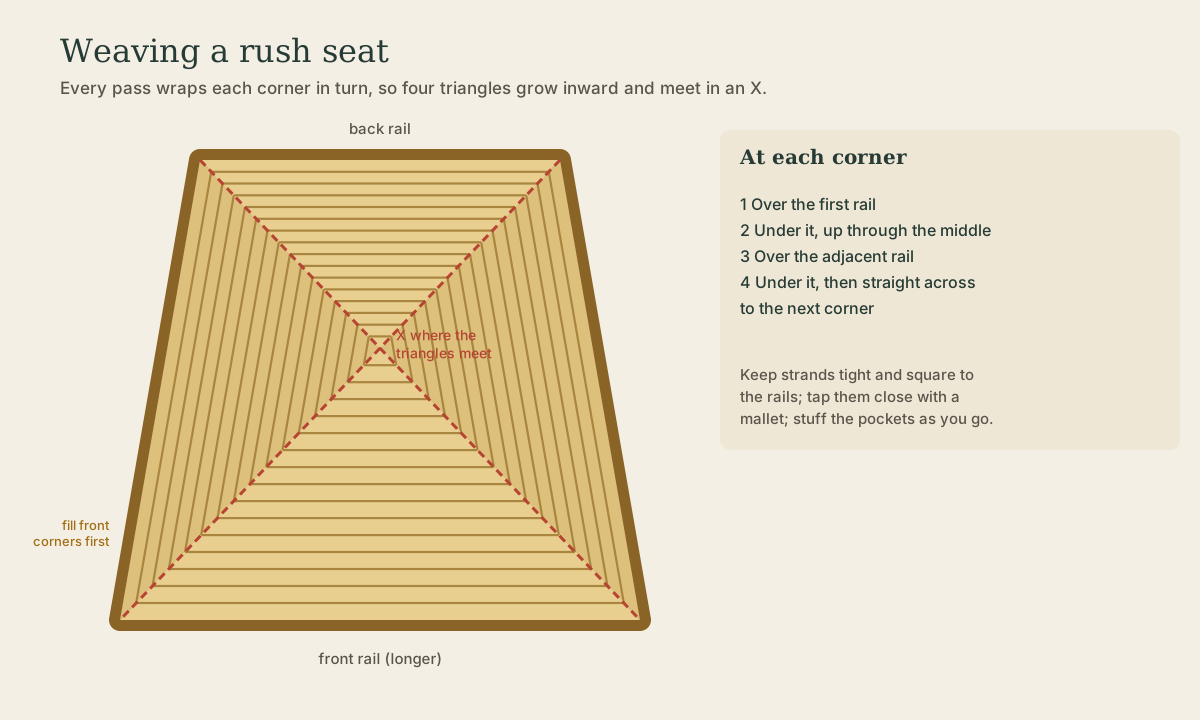
Rush is woven around the rails, wrapping each corner in turn 1:
- Tack or hold the end inside a rail at one corner.
- Go over the rail next to the corner post, under it, and up through the center of the opening.
- Go over the adjacent rail, under it, and pull straight across the opening to the next corner.
- Repeat at every corner, round and round. Each pass covers all four corners, so four triangles grow toward the middle and meet in an X 1.
Keep strands square to the rails and snug against each other; tap them together with a mallet over a soft block 1. Tension should be even and tight. Twist the strand as you go on the top side; the underside needn’t be twisted 1.
Stuff the pockets between the top and bottom layers as you go, with the same material - rush butts in a rush seat, kraft paper in a fiber seat - packing firmly with a tapered hardwood stick. Stuffing builds up the seat and keeps it from breaking down at the inner rail edges and sagging 1.
Quick check
Perry stuffs with the same material - rush butts in rush seats, kraft paper in fiber seats.
Tapered and rectangular seats
Tapered seats (front wider than back, the usual chair): lay a square against the side rail at each back corner and mark the front rail - or measure half the difference between front and back rails in from each front corner. Fill those front-corner spaces first with short strands wrapped only around the front corners, until the remaining opening is square 1.
Rectangular seats: the short rails fill first. Finish by passing back and forth between the long rails in a figure-eight - over and under one long rail, up through the center, over and under the other - until the gap closes. The center strands must be compressed hard with a mallet to fit 1.
Playback is optional. If the player is unavailable, open the video at its source.
Quick check
Mark half the difference between front and back rails in from each front corner and fill those spaces first.
Finish
Natural rush can be left as is or sealed with thin shellac or a linseed oil-turpentine mix; fiber rush is often sealed with shellac or varnish to resist moisture and dirt. Restoring and matching antique rush is covered in The Caner’s Handbook 2.
What to take from this
Gather cattail green in mid-August, dry it in the shade, soak about ten hours, and twist tight strands; or use fiber rush, dampened but never soaked. Wrap every corner in rotation - over, under, up the middle, over the next rail - so four triangles meet in an X, tapping strands tight and stuffing the pockets. Fill the front corners of a tapered seat first, and finish a rectangle with figure-eights between the long rails.
Lesson complete
Nice work.
Sources for this lesson
- 1L. Day Perry. Seat Weaving. The Manual Arts Press. 1917. verifiedPublic-domain manual on the seven steps of caning, cane webbing, rush seating (cattail and flag gathered in August, twisted strands, stuffing, filling rectangular and irregular seats), and reed and splint seats.
- 2Jim Widess, Bruce W. Miller III. The Caner's Handbook: Restoring Cane, Rush, Splint, Danish Cord, Rawhide, and Wicker Furniture. Schiffer Publishing. verifiedCurrent publisher page for the updated illustrated handbook covering rush, splint, Danish cord, rawhide, wicker, repair, and maintenance.